
AeroMag Forge: materials innovation begins inside the company
· By Antonio Sedino · Reinventy Solutions Corp.
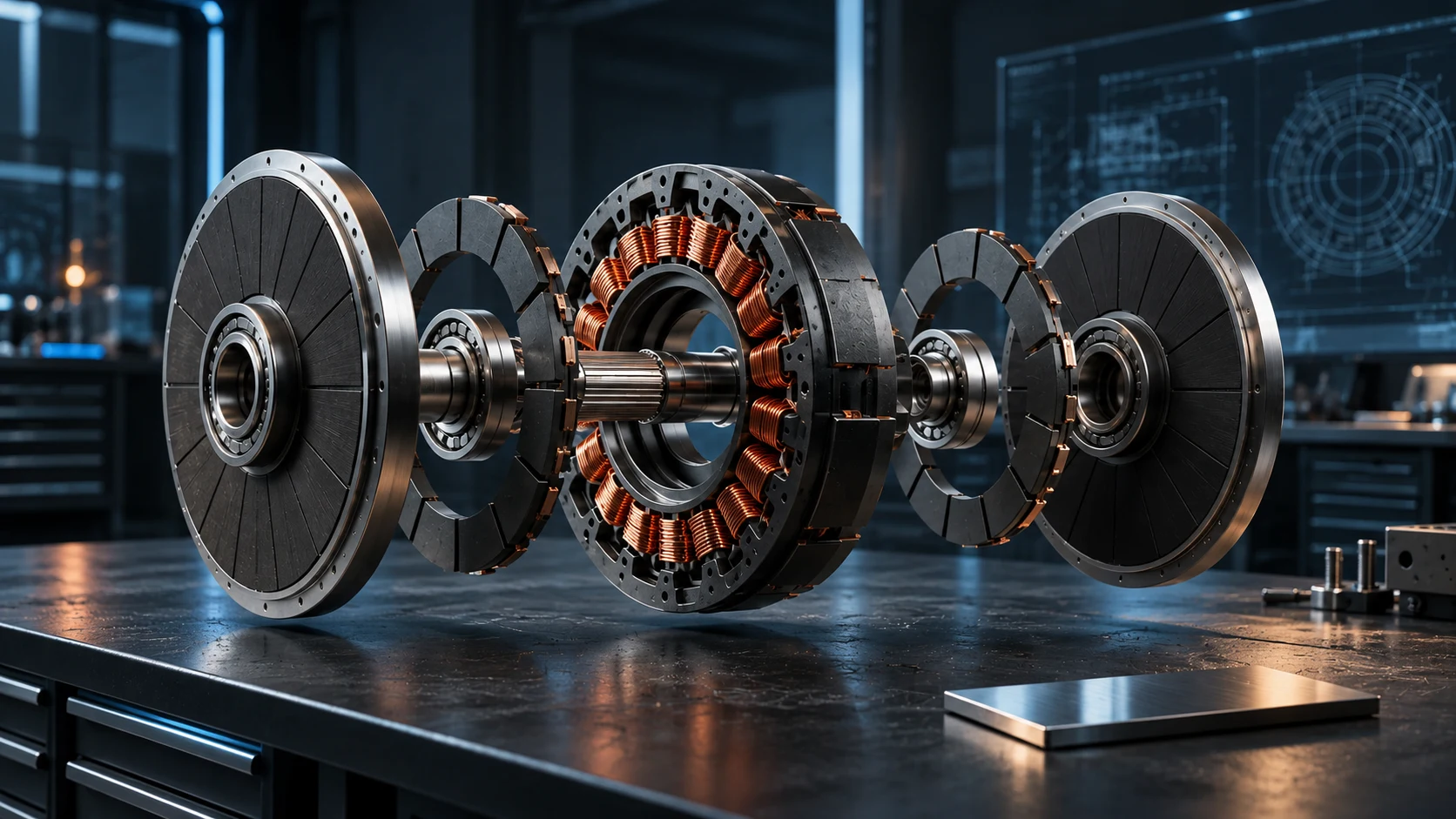
Low-power edge computing, proprietary knowledge and verifiable engineering: Reinventy’s project aims to connect materials research with electric machine design while keeping industrial knowledge under the company’s control.
The right material can change an entire machine. It can affect weight, losses, heat management, service life and even how the machine is manufactured. For a company developing new technology, the question is not simply which materials to buy. It is how to turn what it knows into materials and products it could not previously make.
This is the space occupied by AeroMag Forge, Reinventy’s project for electric machine engineering and the connections between materials, geometry, manufacturing and evidence. Work with Alchemi, the materials research programme, looks towards a broader path: from informed selection of existing materials to proposing new combinations and new candidates for validation.
The most valuable asset is what the company has learned
An industrial laboratory accumulates far more than documents. It retains successful and unsuccessful experiments, relationships between processes and properties, supplier constraints, observations and decisions. This knowledge becomes useful when it can be queried and compared without losing its source or context.
An internal system can help connect that information, identify gaps and suggest which experiments deserve attention. The architectural choice is to keep data, models and decisions under the company’s control, reducing the need to send confidential formulations, drawings and results to external services.
Sovereignty also means deciding who can access what, which model is used and how to reconstruct a conclusion. Locating a computer internally is a starting point: access controls, service separation, protected archives and verification remain part of qualification.
Edge computing changes where computation becomes useful
Compact platforms can now run artificial intelligence models close to instruments and data. As a public reference, NVIDIA specifies up to 67 INT8 TOPS and power modes from 7 to 25 watts for Jetson Orin Nano Super. That advertised maximum concerns particular inference operations, with precision and sparsity conditions. It does not measure the speed of a physics solver or the electricity consumption of the complete system.
The practical opportunity is to allocate work well. An edge node can run models that fit its memory, analyse signals, organise documents and apply already trained predictive models. Demanding training and high-fidelity simulations may require more powerful company resources. Time to solution also matters: fewer watts do not automatically mean less energy for every problem.
For a laboratory, this architecture brings intelligence closer to the test bench and reserves more expensive computation for the questions that need it. Useful computing power comes from choosing the method and model as well as the hardware.
From material properties to design decisions
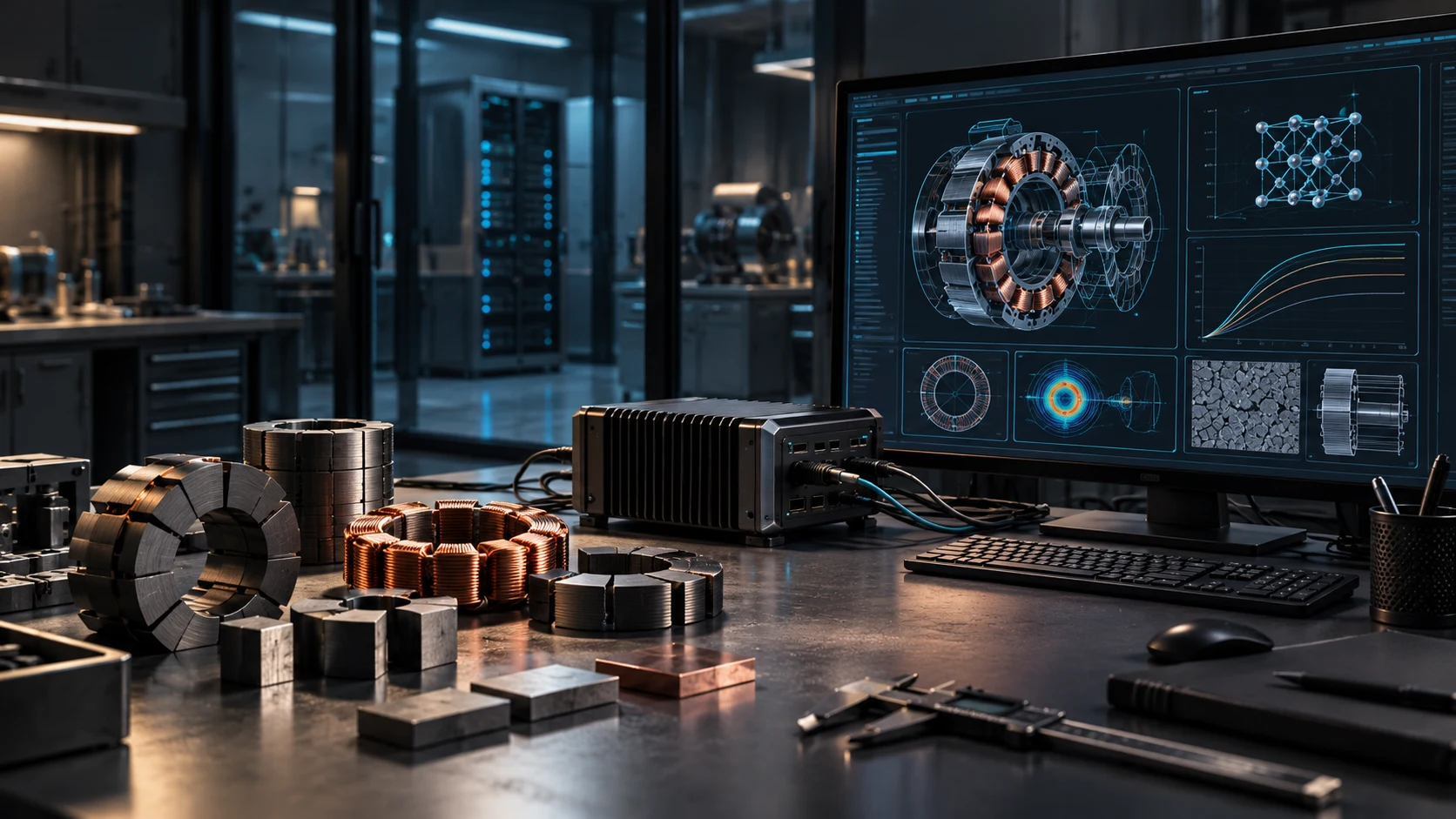
AeroMag Forge is intended to make the relationship between material properties and electric machine design choices visible. A change may help one objective while making another harder: magnetic performance, thermal behaviour, mass, manufacturability and cost must be considered together.
The software already includes tools for exploring conceptual configurations, performing deterministic calculations and checking information for consistency. One rule guides the project: a result must identify its origin and the level of evidence supporting it. An assumption, a property derived from a document, a simulation and a measurement are different forms of evidence.
Qualified connections to materials data and expanded simulation capabilities are part of the development programme. A conceptual geometric model is not yet a production-ready component; passing a software check does not certify physical performance.
Discovery means proposing, verifying and learning
International research has already shown that learning models can expand the search for material structures and properties. GNoME, published in Nature in 2023, illustrates that scientific direction. It is not evidence of AeroMag Forge’s performance, nor does it establish that every suggested candidate can be manufactured.
Reinventy’s objective is to build a cycle in which company knowledge, models and engineers work together to select better hypotheses. The system will be able to suggest candidates, compare trade-offs and guide the selection of experiments. Confirmation will require characterisation, repeatability and assessment under real operating conditions.
Discovering a new material therefore remains an outcome to demonstrate. Artificial intelligence can help teams search more systematically, retain what they learn and explain why a candidate merits the next experiment.
A laboratory that retains control of its future
For Reinventy, the direction of AeroMag Forge and Alchemi is to bring together internal tools, computation matched to the task and an understandable chain of evidence. A company should be able to grow its technical knowledge as it develops new products, retaining control of the information that sets it apart.
The ambition is practical: make the path from an industrial question to a material candidate, and from the material to the machine, more accessible. Credibility is built at each step through verifiable results and decisions for which the company retains responsibility.
Explore AeroMag Forge and Project Daedalus:
Explore the AeroMag electric-machine platform:
Public sources
NVIDIA Jetson Orin Nano Super specifications and performance conditions: https://www.nvidia.com/en-au/autonomous-machines/embedded-systems/jetson-orin/nano-super-developer-kit/
NVIDIA explanation of sparse performance and power modes: https://developer.nvidia.com/blog/nvidia-jetson-orin-nano-developer-kit-gets-a-super-boost/
Merchant and colleagues, Scaling deep learning for materials discovery, Nature, 2023: https://www.nature.com/articles/s41586-023-06735-9