
THOLON: intelligence becomes an asset the business can own
· By Antonio Sedino · Reinventy Solutions Corp.
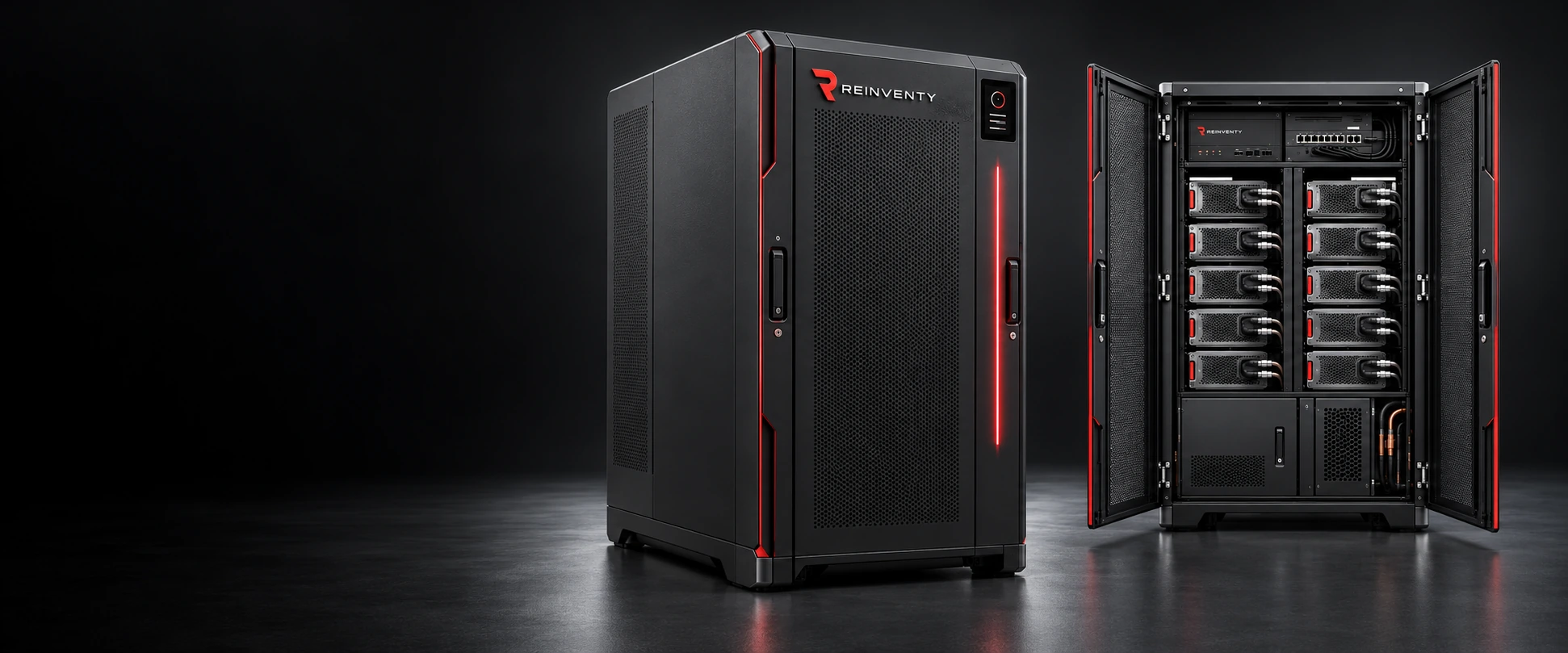
Reinventy presents its flagship micro data center programme: NVIDIA Blackwell computing, proprietary software and a clear ambition—to let organisations build AI capability around their own knowledge, on their own terms. Commercial launch is targeted for Q1–Q2 2027.
A company’s most valuable knowledge rarely lives in one place. It sits in engineering drawings, test results, production experience, source code and decisions whose reasoning has never quite made it into a manual. Artificial intelligence can connect that knowledge. The more consequential question is who controls the infrastructure through which it becomes useful.
With THOLON, Reinventy Solutions Corp. is making that question a product decision. The company is developing a modular micro data center as a flagship programme in its sovereign AI portfolio, bringing local computing together with Tin Man OS, Alchemi and AeroMag Forge. Its intended role is substantial: a working environment in which an organisation can turn its own knowledge into research, design and operational capability while retaining authority over how that knowledge is used.
Commercial launch is targeted for Q1–Q2 2027, spanning the first and second quarters. THOLON remains in development; final configurations, supported workloads and delivery terms will follow engineering qualification. The ambition, however, is already clear: AI should become part of the company’s productive infrastructure.
Independence is the ability to choose
Reinventy’s philosophy starts with a practical definition of sovereignty. An organisation should be able to decide where its authorised AI workloads run, which models they use, what information they may access and which actions require a person’s approval. The ability to change a model, preserve an execution record or restore a service matters as much as the ability to generate an answer.
This is an ambition of operational independence, rather than a claim of independence from every technology supplier. THOLON relies on NVIDIA hardware and a wider software ecosystem. Model licences, updates, replacement components and maintenance remain real dependencies. Keeping approved work local creates choices within those dependencies; it does not make them disappear.
For a business, that distinction has value. A team can plan a local service around confidential design files, reserve resources for a critical workflow and establish its own retention rules. Offline continuity is an engineering requirement to demonstrate, with the required models, licences and tools already available locally.
A compact infrastructure with room to grow
The reference THOLON 10 module brings together ten NVIDIA Jetson T5000 compute nodes, an integrated control PC, internal networking, protected power and a liquid-cooling design. Each T5000 provides 128 GB of nominal memory. Across ten nodes, that is 1,280 GB of distributed memory—not a single shared GPU memory pool.
The component specifications support an aggregate nominal peak of 20.7 PFLOPS of sparse FP4 AI computation for ten nodes. That figure describes a sum of component peaks, not a measured THOLON benchmark, single-model speed or general-purpose simulation performance. It establishes the scale of the proposed computing foundation; useful capacity depends on the model, runtime, networking and workload.
The architecture is designed to extend to four modules. An optional external DGX Station broadens the configurations available for workloads that need a different balance of computing and memory. Expansion must be justified by the work it enables, rather than by a larger headline number.
The decisive layer is what runs on it
THOLON’s defining proposition is the integration of Reinventy software with local Blackwell computing. Tin Man OS is intended to govern models, resources and permitted work. Alchemi provides the research direction around materials and new technologies. AeroMag Forge brings the engineering workflow around electric machines and related systems. Their integration into THOLON is part of the product development programme, with capabilities to be qualified as a system.
Consider an engineering department evaluating a new machine. Requirements must be interpreted, earlier designs found, alternative materials examined and simulation inputs prepared. A useful AI environment helps connect those tasks while preserving the identity of the documents, tools and results involved. Numerical solvers retain their own verification methods. Engineers retain responsibility for acceptance.
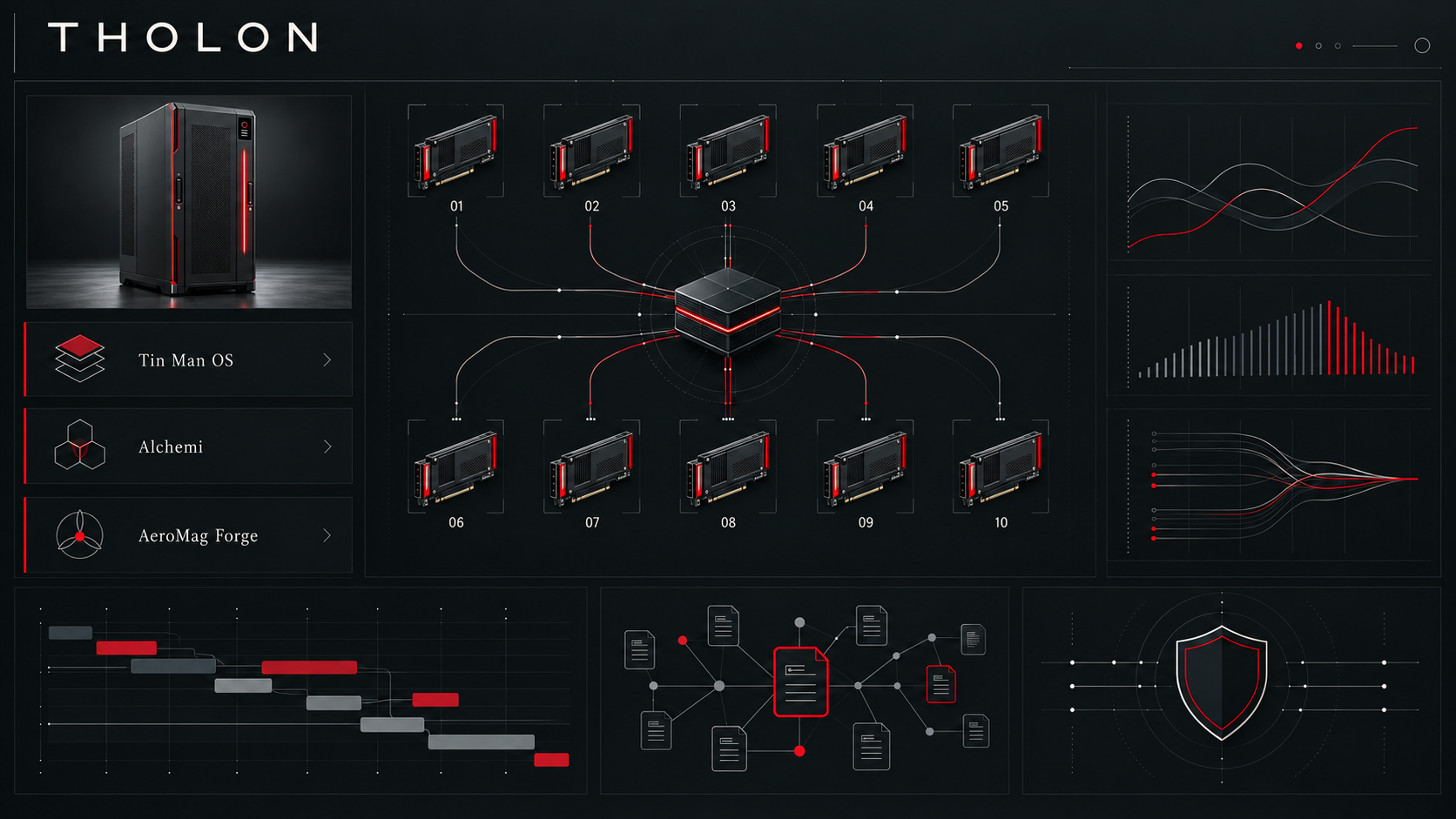
The same principle applies to a machine builder comparing design variants, a research team investigating a material, or an analyst reviewing authorised technical sources. The opportunity is a more coherent path from evidence to decision, with fewer disconnected steps and a record that can be examined afterwards. Specific time savings and engineering outcomes still need to be measured on representative projects.
Models selected for the work
The planned model-management approach allows different specialists to handle different tasks: document interpretation, software assistance or preparation of a domain-specific analysis. A coordinator can route the work and retain its provenance. A separate path explores distributing one larger model across several nodes where the model, runtime and interconnect support it.
These are different execution strategies. Ten nodes do not automatically behave as one larger GPU, and ten assistants do not automatically produce a better answer. Model selection, quantisation, memory planning, concurrency and quality evaluation determine the usable service. Where appropriate and permitted by the model licence, targeted adaptation can help address company-specific vocabulary and tasks. Training a frontier model from scratch is a separate undertaking.
Efficiency begins with doing the right work
Energy efficiency is a design priority. A compact local architecture, right-sized models and deliberate scheduling can avoid using a larger resource for every request. The important measure is the energy required for an accepted result at the necessary quality and response time.
The initial engineering envelope is 2.5–3.0 kW at the loads for one module, subject to the final bill of materials and measurement. Grid demand must also account for UPS losses and battery charging; the installation must address heat rejection and room cooling. An external DGX adds its own requirements. These are design figures, not a certified consumption claim or proof of lower energy use than every cloud alternative.
THOLON’s efficiency case will therefore be demonstrated through workload-level measurements: quality, throughput, latency, energy and recovery behaviour. The aim is meaningful local capability within a controlled energy budget.
Protecting know-how requires governance
Keeping sensitive material within the organisation’s chosen infrastructure can reduce the need to send it to external inference services. Protection also depends on access control, network policy, encryption, separation between projects, backups and tested restoration procedures. A local cabinet alone cannot provide sovereignty.
For Reinventy, the larger objective is to preserve the company’s capacity to understand and develop what it knows. Models should help people work with that knowledge without making its use inseparable from a service the company cannot govern.
THOLON gives that philosophy an industrial form: a compact, expandable foundation for organisations that want AI to become a durable part of their own capabilities. The next milestone is to turn the reference architecture and integrated workflows into a qualified commercial product, with launch targeted for Q1–Q2 2027.
Explore THOLON
The product page explains the architecture, software ecosystem, reference configurations and application scenarios. It is available in English, Italian, French, German and Japanese.
Explore THOLON · EN https://reinventy-solutions.ca/en/platforms/tholon
Esplora THOLON · IT https://reinventy-solutions.ca/it/platforms/tholon
Explorer THOLON · FR https://reinventy-solutions.ca/fr/platforms/tholon
Discuss your application · EN https://reinventy-solutions.ca/en/engage?intent=technology#structured-inquiry
Parliamo della tua applicazione · IT https://reinventy-solutions.ca/it/engage?intent=technology#structured-inquiry
Parlons de votre application · FR https://reinventy-solutions.ca/fr/engage?intent=technology#structured-inquiry
Editorial and technical notes
This is a Reinventy product introduction published by HERALD, a Reinventy Solutions publication. Source basis: THOLON product presentation, Reinventy hardware specification SEA HW 001 and software specification SEA SW 001, revision 1.0, 20 October 2026; current NVIDIA component documentation checked on 29 October 2026. The launch window is a company target. Product qualification and commercial availability remain forthcoming. The rack is an industrial design concept; the control illustration is an AI-generated editorial concept and depicts no measured telemetry.
NVIDIA Jetson Thor https://www.nvidia.com/en-us/autonomous-machines/embedded-systems/jetson-thor/
NVIDIA DGX Station https://docs.nvidia.com/dgx/dgx-station-development-guide/Intro.html