
Tin Man’s next chapter: building a synthetic copilot that learns
· HERALD Editorial Desk · Reinventy Solutions Corp.
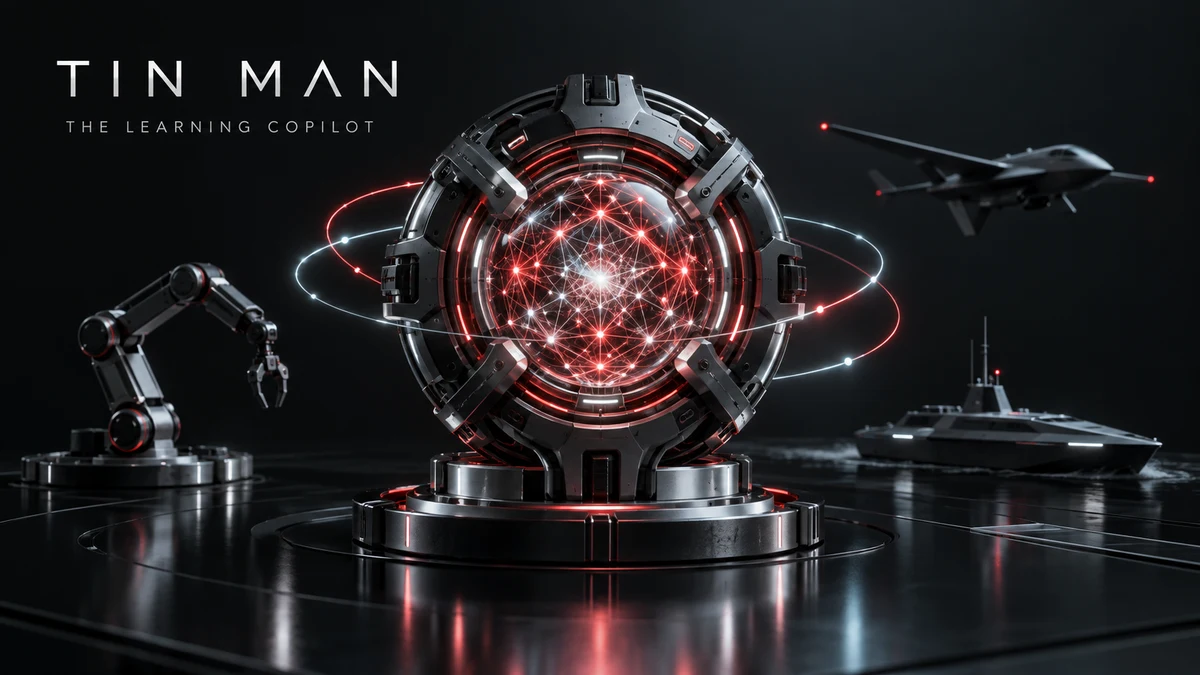
Inside Reinventy’s Gemma-based L4 research programme: a shared cognitive core, persistent memory and local learning experiments on NVIDIA Jetson AGX.
There is a demanding question behind the next chapter of Tin Man: can a synthetic copilot carry useful experience from one task into the next, turn a human objective into executable work, and show why its result should be trusted?
Reinventy is developing that answer through its L4 research programme. At its centre is a Gemma-based cognitive candidate designed to bring perception, memory, planning and domain skills around a shared model, with computation and experimental learning carried out locally on NVIDIA Jetson AGX infrastructure.
The ambition is practical. A copilot should be able to receive an objective, recover the relevant context, choose permitted tools, carry out a bounded task, inspect the result and retain what was learned. The work already includes a functioning candidate with persistent memory, durable execution, real local training experiments and tested recovery. Broader autonomy remains the next qualification frontier.
A shared cognitive core
The candidate explores a different way of organising an intelligent system: one principal model shared by cooperating cognitive modules. Perception organises incoming observations. Attention selects relevant context. Planning structures the work. Memory preserves knowledge and episodes. Evaluation examines outcomes and uncertainties.
These modules retain separate responsibilities while working with a common operational state. Their purpose is to connect an instruction with the evidence, tools and history needed to act on it. Sharing a model does not mean every module receives unrestricted access to every record, or that specialised scientific computation is replaced by generated prose.
Gemma 4 12B Unified is the experimental model at the centre of this candidate. Google's model documentation describes support for text, images and audio inputs. Those model-level capabilities provide a foundation; useful performance inside Tin Man still has to be measured in the complete system. In particular, reliable speech understanding remains a qualification task, rather than an inference drawn from the model's multimodal label.
What it means to remember
For an operational copilot, memory must survive the end of a conversation. It must distinguish a supplied fact from an observation, a working hypothesis from a checked result, and an attempted procedure from a reusable skill.
Tin Man's candidate preserves memories and episodes with provenance. Its execution state survives interruptions and restarts. A completed operation can retain a receipt so that recovery does not simply repeat work with consequences. A cancelled or interrupted job remains an identifiable operational state, rather than disappearing inside a chat history.
This continuity matters across different applications. A research assistant may need the conditions of an earlier experiment. An engineering copilot may need the assumptions behind a previous calculation. A domain agent may need to recover the last verified step of an interrupted workflow. The shared requirement is a reliable relationship between context, action and recorded outcome.
From experience to learning
The learning programme has two distinct layers. The first is operational learning: retaining episodes, retrieving useful context and making verified procedures available for later work. The second is parameter adaptation through local training experiments, with candidate adapters saved, reloaded, evaluated and, where necessary, rolled back.
Real local training has been performed on the target computing platform. That establishes an experimental training path; it does not by itself establish general improvement. A lower training loss or a plausible answer on a familiar example cannot show that a system has acquired a robust new competence.
The decisive test is performance on separate cases, alongside checks that existing capabilities have not regressed. Some experimental speech adapters were rejected after evaluation exposed regressions. Preserving that result is part of the method: an unsuccessful candidate must not become the active model merely because it is newer.
A useful learning system must be able to reject its own proposed improvement when the evidence does not support it.
The next operational frontier
The central engineering objective is an end-to-end loop: objective → plan → permitted tools → verified result → retained experience.
Consider an illustrative research task: recover an experiment's recorded temperature, convert it into Kelvin and prepare a report. The required capability extends beyond producing the right sentence. The system must identify the right record, recognise missing information, choose the conversion, write the intended output and verify it. It must also handle tool errors, cancellation and restart without quietly substituting a different objective.
The current candidate already exercises bounded tools for calculations, conversions, memory retrieval, file creation within its own workspace and paper financial analysis. Generalising beyond prepared procedures, linking model-generated plans reliably to execution and demonstrating useful learning across goals remain work to complete.
That distinction defines the programme's current stage. L4 is the development target for broader governed autonomy. The candidate has not been qualified as general L4 autonomy, and its successful software checks do not establish AGI, unrestricted self-improvement or human-like consciousness. Production replacement and physical full-duplex voice qualification remain separate acceptance decisions.
Intelligence under an explicit mandate
The person delegating a task remains the source of operational authority. A more capable model does not automatically receive a broader mandate. The mechanisms that authorise tools, delimit resources and stop execution remain outside the cognitive component being developed.
This separation gives the copilot a concrete engineering boundary. It can reason about an objective and propose a course of action; execution still depends on the permitted scope. It can produce a candidate skill or adapter; acceptance still depends on independent checks. It can retain experience; provenance and correction remain necessary.
For industrial applications, those properties are central to usefulness. An operator needs to know what was requested, what actually ran, what evidence was produced, which uncertainty remains and whether an interrupted task can be recovered safely.
One research direction, multiple application domains
The common cognitive architecture is intended to support specialised applications rather than assume that one generic interface is sufficient for every sector. Reinventy's wider portfolio includes autonomy, engineering research and domain-specific agents. Each application brings its own tools, evidence requirements and validation work.
ARC provides one research context for examining synthetic cognition in a financial domain. Naval and airborne platform programmes raise different questions about perception, mission context and the relationship between software and physical systems. None of those applications can inherit a qualification simply because it shares a cognitive core.
Tin Man OS is the associated operating-system project within Reinventy's technology portfolio. The experimental Gemma successor and the operating-system release line are related development efforts with separate acceptance states; the candidate is not being presented here as an already released replacement for the production architecture.
Building the learning copilot
Reinventy's direction is a synthetic copilot that can understand an objective in context, retain experience, make bounded decisions and complete useful work with evidence. The candidate now provides a working foundation for testing that direction: shared model execution, persistent memory, durable tools, local training experiments and recovery.
The next advance will be judged through complete tasks and new cases: whether the system carries the intended objective through to the right result, whether experience improves subsequent performance and whether that improvement survives independent checks.
Explore the Tin Man architecture and Reinventy's wider technology portfolio: https://reinventy-solutions.ca/technologies/tin-man
Discover the Tin Man OS project: https://reinventy-solutions.ca/products/tin-man-os
Discuss an application with Reinventy: https://reinventy-solutions.ca/engage
About this feature
This original HERALD feature describes Reinventy's development programme and candidate evidence reviewed through 11 October 2026. The cover is an AI-generated concept illustration of the research direction, not a photograph of a deployed product.
Technical background on the model and computing platform: https://ai.google.dev/gemma/docs/core/model_card_4 https://docs.nvidia.com/jetson/agx-thor-devkit/user-guide/latest/