
ALCHEMI: From Material Selection to Material Creation
· By Antonio Sedino, CTRO · Published by Reinventy Solutions Corp.
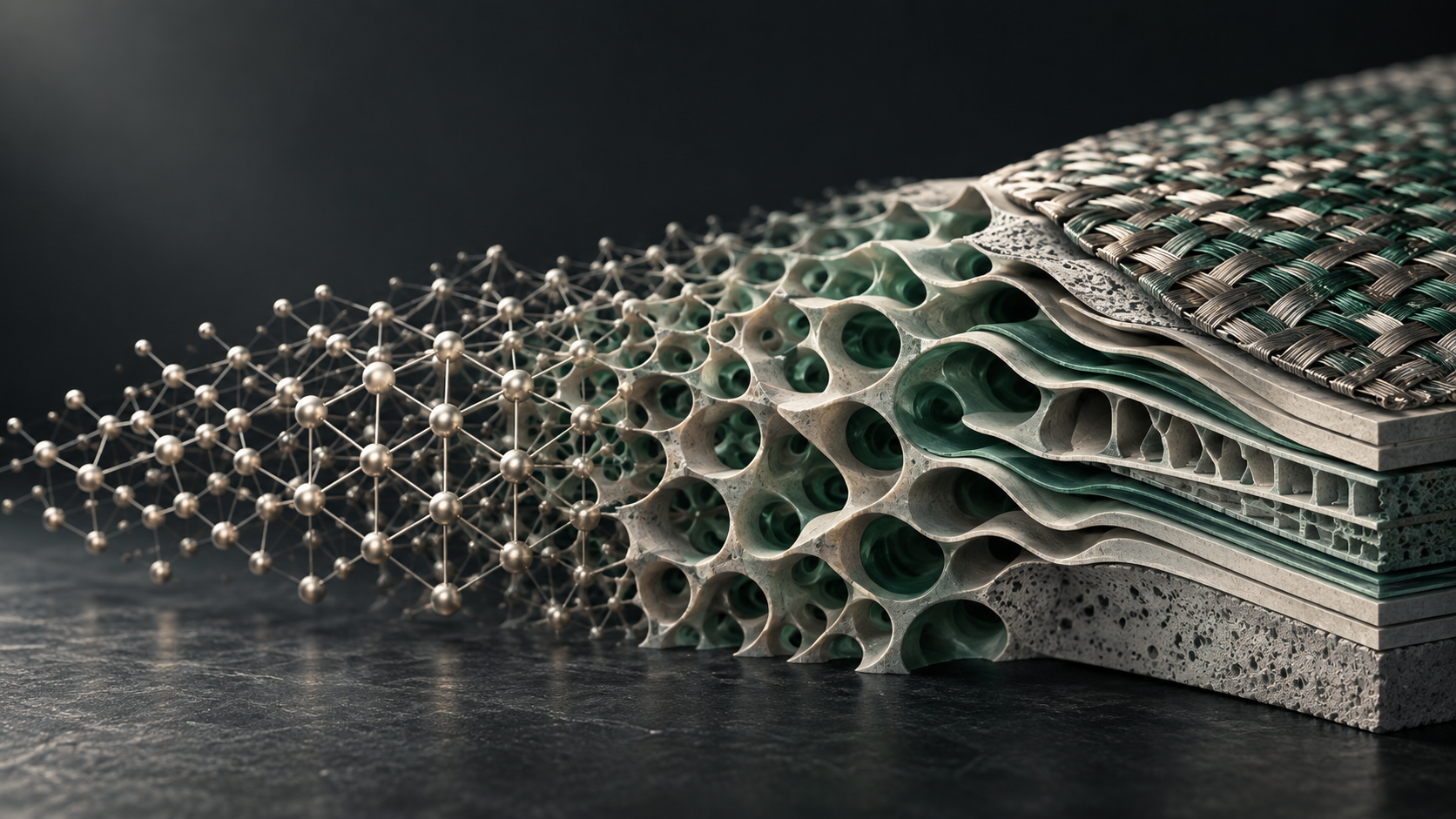
Inside Reinventy's materials R&D programme: how application-led design, new candidate architectures and traceable evidence could change the way advanced materials are conceived, investigated and brought towards physical validation.
The next design decision may begin inside the material
A lighter structure can change the aircraft that carries it. A surface that handles heat differently can change the cooling system around it. A composite that combines several functions can change how many components an engineer needs in the first place. Materials research reaches far beyond the specification of a substance: it can redraw the boundaries of a machine.
That is the opportunity behind ALCHEMI, Reinventy's materials research and development programme. Our aim is to move further upstream in engineering, towards the creation of material candidates designed around what a future system needs to do. The question becomes: what composition, internal structure or arrangement of layers might make this requirement achievable?
This is the step in quality we are pursuing. A research platform becomes more valuable when it can help construct a new hypothesis, explain why that hypothesis deserves attention and carry it into an experiment that could prove it wrong. The ability to propose something new matters. The ability to investigate it coherently determines whether it becomes useful.
ALCHEMI is being developed around that connection. It brings scientific reasoning, material representations, computational tools and an evidence trail into a common workflow. Generating new candidates is central to the ambition; establishing what those candidates actually do remains the purpose of the research.
Working backwards from the application
Many engineering projects begin with an available material and ask how far it can be pushed. Inverse design begins with the required behaviour and explores the material configurations that might produce it. Both approaches have a place. The second opens a different search space, especially when no existing option satisfies the full combination of requirements.
Consider a lightweight enclosure exposed to repeated heating and mechanical load. A useful brief would describe the thermal environment, the permitted mass, the loading conditions and the constraints imposed by manufacturing. Optimising one attractive property in isolation could produce a candidate that fails elsewhere. The research problem is the relationship between those requirements.
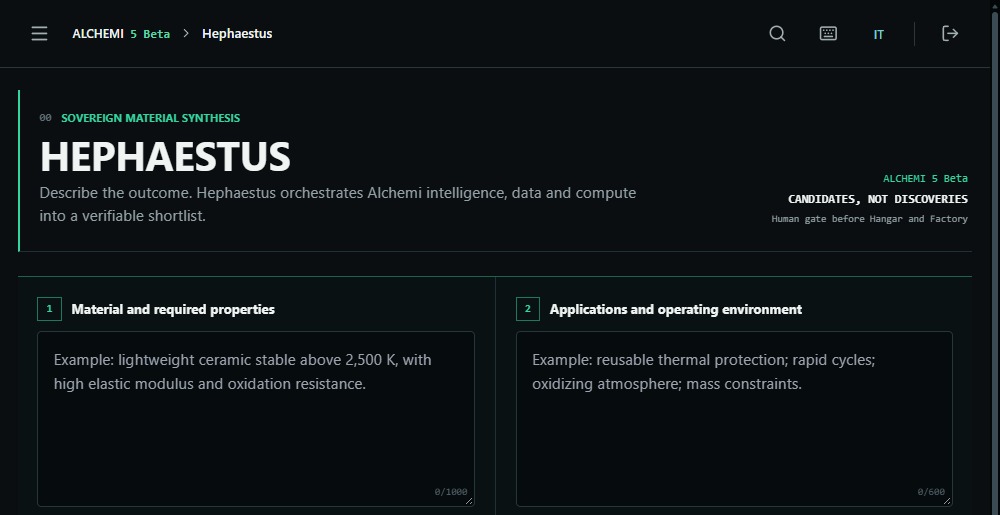
In ALCHEMI's Hephaestus workbench, that distinction is visible from the beginning: one brief describes the material and its required properties; another describes the application and operating environment. Quantitative requirements can then make the design question more precise. The application gives the scientific search a reason and a boundary.
This is also where engineering judgement remains indispensable. A requirement must be interpretable, internally consistent and connected to a measurement. An AI system can help expose omissions or competing objectives. It cannot make an undefined acceptance criterion scientifically meaningful merely by assigning it a score.
New materials have more than one form
Materials invention is often illustrated with atoms arranged into a new crystal. That is one important route, but it is only part of the field ALCHEMI is intended to serve. A useful material hypothesis may involve a crystalline structure, a polymeric system, a composite formulation or an engineered internal architecture.
Those categories require different representations. A laminate needs a description of its constituents, layup and interfaces. A cellular structure needs geometry as well as a base material. An atomistic candidate requires a representation appropriate to atomic positions and chemistry. Treating all of them as the same kind of object would make the resulting analysis difficult to trust.
Our development work has therefore included the separation of composite studies from atomistic generation. In the composite workflow, source-linked constituent choices, comparative coupon designs, quantities and manufacturing considerations can belong to the same study. A matched control helps make a subsequent comparison interpretable. These are practical foundations for an experimental programme.
Such work generates something concrete at the design level: a proposed material configuration and a study through which it can be examined. It does not establish a new physical property by itself. The distinction allows the programme to pursue invention with greater precision, because each representation is judged by the evidence appropriate to it.
A research engine needs several ways to be right
An attractive candidate is a beginning. It needs screening, comparison and an honest account of where the available methods apply. A fast computational model can help narrow a large search. A more expensive analysis may investigate a smaller set. A different method can test whether the first result depends too heavily on one set of assumptions.
The ALCHEMI development path connects candidate generation with that broader research cycle. Its scientific ambition includes both bounded exploration of known design spaces and deeper generative approaches. These paths have different maturity levels. A generative run that does not produce a usable candidate is an incomplete result; it cannot be converted into a discovery through presentation.
The same principle applies to predicted properties. A prediction is useful when its domain, assumptions and uncertainty are understood. A model that has not been calibrated for a particular material family cannot provide the same confidence as one tested against relevant reference evidence. Increasing computational depth is valuable only when it answers the right question.
For that reason, we see the research platform as a way of organising methods and decisions. It should make it easier to identify what supports a candidate, what contradicts it and what still needs to be measured. The desired outcome is a stronger next experiment, with a clearer reason for undertaking it.
What the workbench already makes tangible
The programme is more than a visual idea. Development records document source-bound composite study variants, comparative controls, checks on quantities and layups, and technical dossiers linked to their research context. The live Beta workbench exposes the separation between the design brief, candidate studies and later engineering stages.
Hephaestus gives the work a structured starting point. Hangar provides a place for candidate review. Archive preserves supporting records. Factory carries a selected study towards a draft engineering handoff. The connection is important: a researcher should be able to follow how a proposal was formed, what evidence accompanied it and what decision moved it forward.
The Factory boundary is particularly meaningful. A manufacturing-oriented document can help define a coupon, organise a bill of materials or prepare a workshop discussion. It remains a draft until the required review and qualification are complete. The existence of a document is evidence of a documented proposal, rather than evidence that a material has been manufactured successfully.
These capabilities support a more continuous R&D process. They also make missing evidence visible. A team can distinguish a design ready for experimental review from a study still waiting for sources, an appropriate analysis or a physical result.
Why multifunctional materials change the engineering conversation
The most interesting opportunities often sit between disciplines. A structural material has thermal behaviour. A thermal barrier has mass, interfaces and a manufacturing process. A functional surface must survive the mechanical and environmental conditions imposed by its host system. Improving one aspect while ignoring the others can move a problem elsewhere.
A multifunctional approach asks whether those relationships can be considered at the architecture stage. Could an internal geometry help manage both mass and heat flow? Could a layered material distribute different functions across its thickness? Could the formulation and process be studied together, so that a promising composition is also a credible experimental proposition?
These are research questions. They explain why ALCHEMI matters within Reinventy's wider materials work, including the public ANIMA and PRIMA programmes. ANIMA frames multifunctional material architecture; PRIMA organises a family of foundational-material research directions. Neither programme name substitutes for the evidence required by a particular candidate.
The potential applications are broad: thermal-management components, lightweight structures, functional surfaces and materials for electric machines are examples of engineering problems that could benefit. Each has different success criteria. A result relevant to one application must earn its relevance to another.
The strategic asset is an accumulating research memory
A research organisation loses value when each new study begins by reconstructing the previous one. Sources become detached from decisions. A favourable prediction survives in a slide while its assumptions disappear. An unsuccessful experiment becomes a forgotten cost instead of information that can improve the next attempt.
ALCHEMI's emphasis on provenance and archived evidence addresses that problem. The objective is a research memory in which briefs, candidate representations, analyses and review decisions remain connected. When physical measurements become available, they should be able to inform that same chain and improve subsequent choices.
For an industrial team, the potential benefit is greater continuity between scientific exploration and engineering development. A candidate can be reconsidered when a requirement changes, a model improves or a new measurement challenges an old assumption. Knowledge becomes easier to inspect and reuse, while proprietary work remains subject to the organisation's data and access controls.
This is also why controlled compute and explicit connectivity choices matter. A materials project may contain valuable know-how long before it produces a qualified product. The way the research environment handles that knowledge is part of its industrial usefulness.
The next milestone has to survive contact with matter
Our direction is ambitious: a research engine that helps create new material candidates, investigate them across relevant methods and carry the most credible proposals towards physical validation. Some workflow capabilities are demonstrated; deeper generation, calibration and application-specific qualification remain active development work. ALCHEMI is an advancing R&D programme, not a claim that every branch of that ambition is complete.
The decisive test is what happens beyond the screen. Can a candidate be prepared as intended? Do independent measurements support the proposed behaviour? Is the result repeatable? Does it retain its usefulness in the conditions that motivated the work? Those questions turn an interesting design into material knowledge.
That is the standard we want to build towards. The promise of ALCHEMI lies in bringing invention and scrutiny closer together: more deliberate candidate creation, more understandable evidence and a better prepared path into the laboratory. If that path succeeds, materials cease to be merely the starting assumptions of engineering. They become an active space in which new systems can be conceived.
Explore the public ALCHEMI programme: https://reinventy-solutions.ca/alchemi?utm_source=herald&utm_medium=referral&utm_campaign=weekly-alchemi-materials
Discover ANIMA and PRIMA through Reinventy's materials portfolio: https://reinventy-solutions.ca/programs
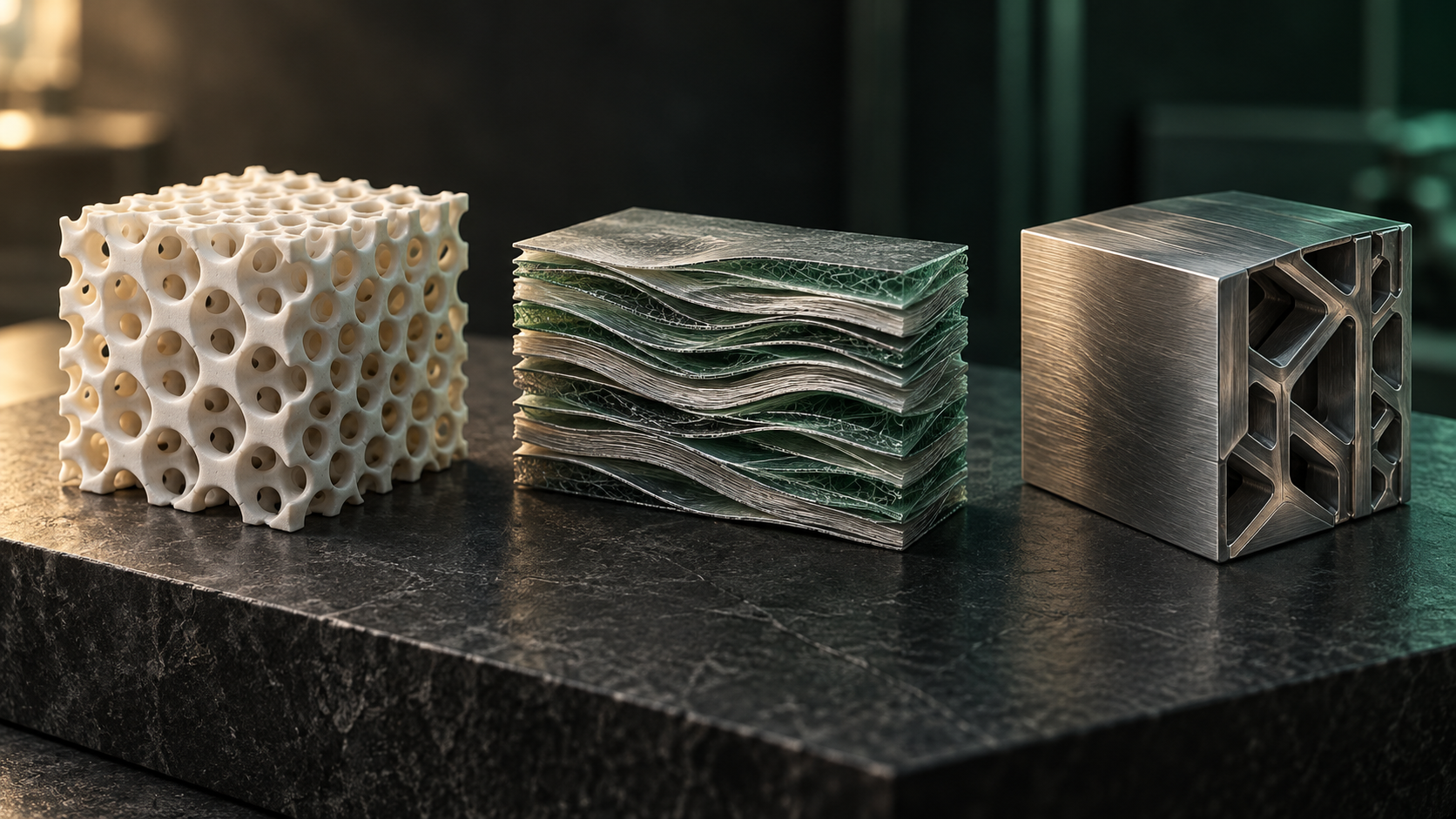
Visual note: the material illustrations are original AI-generated editorial concepts. The interface image is an authentic view of the ALCHEMI Beta workbench. None establishes a material composition, a measured property or a completed physical discovery.