
ARC and IDRA: a financial laboratory for synthetic intelligence
· By Antonio Sedino, CTRO · Published by Reinventy Solutions Corp.
Reinventy AI Lab was created to answer a practical question: can the same synthetic intelligence architecture be specialised for very different environments without losing discipline, traceability or human control? ARC is our first field application in the financial domain. It is the place where the principles behind Tin Man meet market data, quantitative research and tightly bounded operating authority.
Tin Man is not defined by a single interface or a single task. It is a cognitive architecture designed to connect perception, memory, reasoning, evidence and governed tool use. In a machine, perception may come from cameras, microphones or sensors. In ARC, perception begins with markets: prices, liquidity, volatility, momentum, changes of regime and the cost of acting. The domain changes, but the central problem does not. An intelligent system must interpret a changing environment, retain context, compare possible actions and remain inside an authority that a human being can see and control.
ARC turns that architecture into a research environment for each user. It brings together market observation, quantitative analysis, experiment history and user-scoped controls. Research and financial authority remain separate. A model can propose a hypothesis; it cannot grant itself permission to deploy capital. Any financial activation is personal and explicit, and every authorised operation remains subject to limits defined by the user.
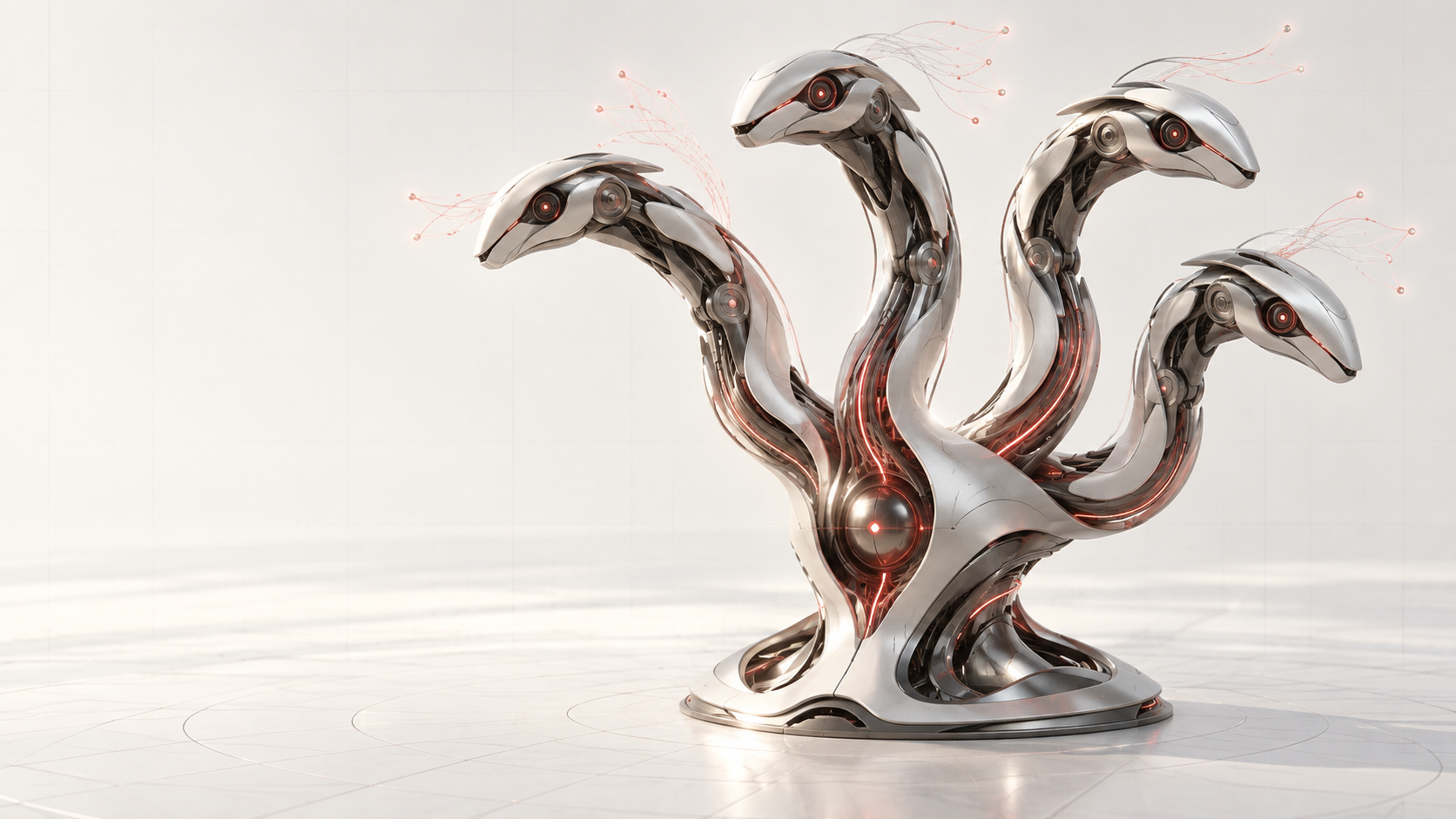
At the centre of ARC is IDRA, named after the many-headed Hydra. The image is more than a visual metaphor. A market rarely offers one stable truth, and a single analytical lens can become dangerously persuasive. IDRA therefore studies the same market through several specialised heads. Each asks a different question, each can be tested independently, and none is allowed to declare itself correct merely because its narrative sounds convincing.
The first head is Trend. It examines whether a directional movement shows persistence rather than treating every price change as a signal. Its task is to distinguish continuity from temporary noise.
The second is Dip Recovery. It studies what happens after a decline, looking for evidence of recovery instead of assuming that a lower price is automatically an opportunity. It does not claim to identify the exact bottom. It asks whether observable conditions support a recovery hypothesis.
The third is Range Reversion. It examines markets that oscillate around a reference interval. Its range is not a rule the market must obey; it is a working hypothesis that must be abandoned when behaviour changes.
The fourth is Breakout. It focuses on moments when a previous range or regime may be giving way to something new. A break can persist or fail quickly, so this head studies the evidence that separates a lasting transition from a false start.
Together, the four heads create a multi-perspective research system: continuity, recovery, equilibrium and change. They are not four independent wallets, and they are not four unrestricted trading agents. They are four quantitative research families connected to one governed architecture.
IDRA becomes more distinctive when those heads can branch. Nemotron can propose structured candidate specialisations inside a permitted research space—for example, a different observation window, threshold or sensitivity. Each base family can produce up to two candidate variants, for a maximum of eight additional research candidates. A new head is therefore a hypothesis, not a promotion. It receives declared parameters and an experimental record; it does not receive financial authority.
The separation of responsibilities is deliberate. Nemotron proposes. ARC validates the format and the permitted boundaries. The quantitative engine measures. Replay and comparison test the candidate against its base family, including modelled costs and drawdown. Failed candidates and insufficient evidence remain part of the record. The model cannot approve its own output, hide an unsuccessful experiment or convert an encouraging backtest into permission to trade.
This is also what we mean by predictive research. IDRA does not know the future. It generates testable expectations about subsequent market behaviour and measures what follows. A trend hypothesis, a recovery hypothesis and a range hypothesis can all observe the same data and reach different conclusions. Their usefulness depends on independent evaluation, realistic costs and performance across conditions that did not determine their design.
The objective is ambitious: to investigate whether a synthetic copilot can contribute to positive, repeatable and risk-adjusted performance after costs. Profitability is a target to be tested, not an outcome that can be promised. Financial markets can move against every model, historical results do not guarantee future results, and losses remain possible. That is precisely why ARC treats risk as part of the architecture rather than as a disclaimer added at the end.
An authorised agent must operate within explicit limits. The user defines the boundaries within which the system may act, including the acceptable exposure and loss constraints. Those controls are intended to prevent an experimental objective from becoming unlimited authority. They reduce risk; they do not eliminate it. ARC is research and operating technology, not investment advice, and no return is guaranteed.
The most important result of ARC may extend beyond finance. It demonstrates how Tin Man can be specialised without becoming a different, opaque intelligence each time the domain changes. Market feeds replace physical sensors; quantitative hypotheses replace navigation plans; execution controls replace machine actuators. The pattern remains recognisable: observe, remember, reason, test, act only when authorised, and preserve evidence of what happened.
That pattern can support future applications in robotics, industrial operations, defence and intelligence, autonomous systems, materials research and other environments where decisions must be both adaptive and accountable. ARC is therefore more than a financial application. It is a demanding proving ground for a broader idea: synthetic intelligence becomes useful when it can specialise, learn from evidence and still remain governable.
IDRA embodies that idea visually and technically. More heads do not automatically produce better decisions. They produce more perspectives that must earn their place. What we are testing is not whether artificial intelligence can sound confident about a market. We are testing whether it can remain measurable, sceptical and controlled when the market proves it wrong.
That is the purpose of ARC: to transform prediction from a claim into a disciplined research process, and to explore whether that process can create durable value without ever confusing possibility with certainty.