
ARC. Intelligence that learns to search for value
· By Antonio Sedino, CTRO · Reinventy Solutions Corp.

Inside Reinventy’s project combining algorithms, quantitative research and Tin Man: a journey through the architecture, experimental results and development of a specialist agent capable of turning experience into competence.
Artificial intelligence is changing how we search for information. The most important transition, however, begins when we ask it to organise work: observe a problem, formulate a hypothesis, test it, recognise the result and use what it has learned. When this sequence enters an economic domain, every word acquires a different weight. Data quality, time, costs and the authority to act become parts of the same architecture.
ARC grows out of this ambition. Reinventy is building an environment in which quantitative research and local intelligence can work together, supporting a path towards Tin Man specialisation. At its centre is a very practical question: how can the ability to explore millions of conditions become knowledge that improves opportunity selection, experimental quality and, over time, the system’s ability to search for value?
The industrial potential we see is enormous. An agent capable of making its own laboratory more productive can affect a decisive resource: the amount of qualified work an organisation can perform before committing capital, time and responsibility. In ARC’s case, that resource meets a particularly demanding setting, where an insight must survive economic friction and where a simulation’s result can differ greatly from that of an operation that can actually be executed.
This editorial explores the project in depth. It presents the algorithm at the level of its public logic, explains the relationship between model and quantitative engine, examines the entire available historical comparison and explores learning. The proprietary implementation, operational thresholds, weights, selection parameters and confidential procedures remain Reinventy’s assets. What we can share is already sufficient to show why ARC represents a strategic direction of considerable importance to us.
When the product is a research system
Understanding ARC starts with the work it should enable. A difference observed between two market conditions may be transient, an incomplete measurement, an opportunity absorbed by costs or a candidate deserving more rigorous analysis. The product’s challenge is to organise these steps, preventing the first impression and the final decision from becoming the same thing.
An economic research system must keep at least three times together. There is the time of observation: when data was collected and which condition it concerns. There is the time of the experiment: which window is studied, under which assumptions and configuration. Finally there is the time of action: when a proposal could have an effect and which conditions must still hold. The connection between these times determines how usable a result is.
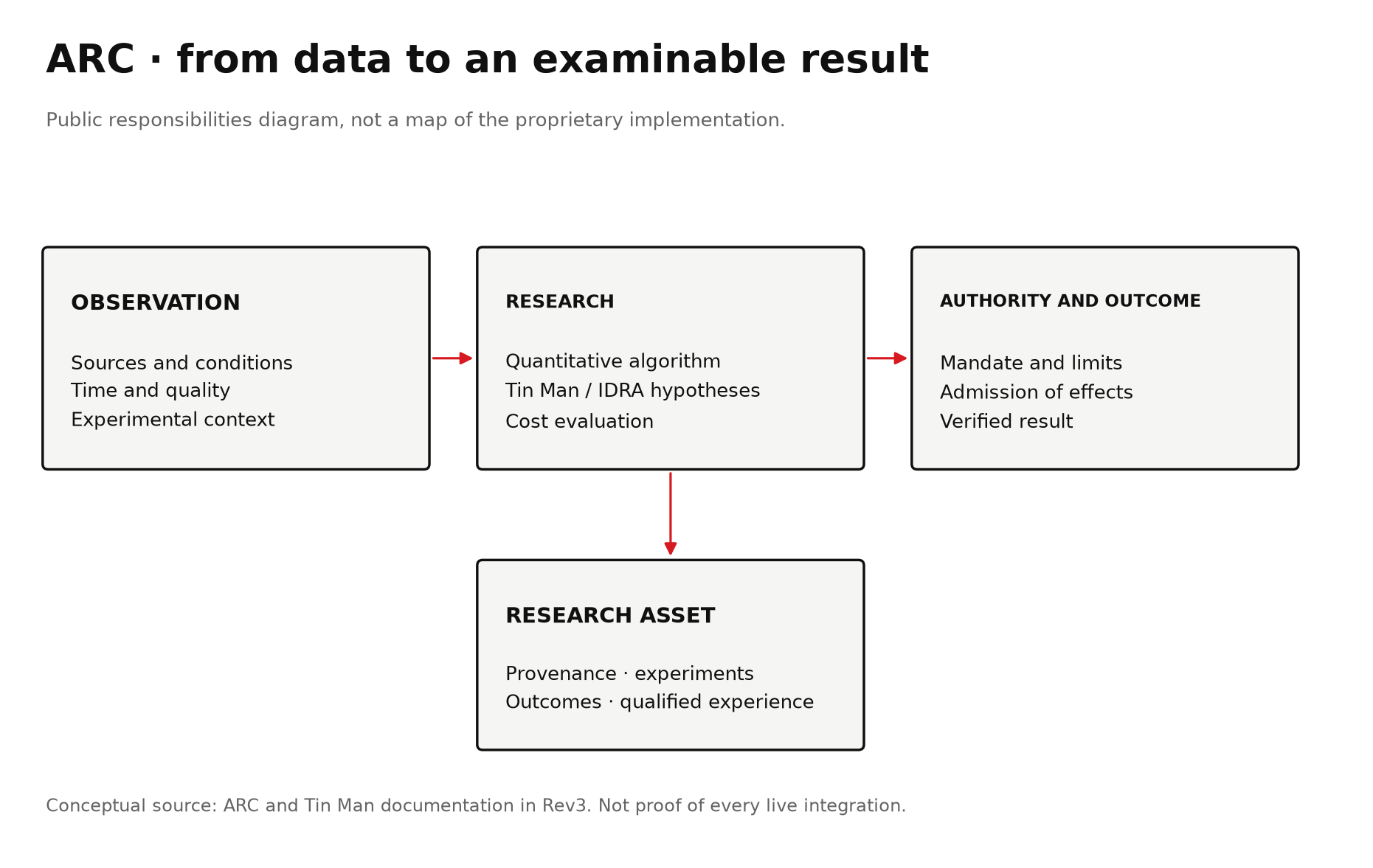
ARC’s architecture connects components with different responsibilities. Collection supplies observations; the quantitative engine builds and evaluates scenarios; Tin Man contributes reasoning and hypothesis generation; the mandate defines the permitted scope. The archive connects these elements to the history of the work. The product’s value emerges from their coordination: each component can offer an interesting capability, but continuity across the whole sequence turns it into an industrial tool.
This also changes the meaning of the interface. A user should not have to interpret a model’s answer as though it were simultaneously an analysis, an authorisation and proof of success. They must be able to understand the work’s stage: available observation, formulated hypothesis, completed comparison, insufficient evidence or a verified result within a precise scope. That distinction must remain readable even when the model’s reasoning is rich and persuasive.
The project material positions ARC for Reinventy members, shareholders and partners. Here we describe the architecture and industrial outlook through documents with declared dates and scopes. We are not describing an offering open to the public or attributing to every integration the status of a capability already qualified for every use. This precision helps readers appreciate what makes the project interesting: building an environment capable of accumulating verifiable knowledge around economically relevant problems.
Millions of comparisons: an asset to interrogate
Research scale is one of the first elements that makes ARC tangible. A retained extract dated 9 November 2026 records, in the CEX subsystem alone, 9,303,298 cumulative comparisons and 71,655 scans since 8 October. The six configured providers were available at the time of the reading. These figures describe repeated observational work through which the machine examined conditions and differences between sources.
A comparison is a unit of research. Its usefulness depends on what is compared, the observation time and the quality of the available conditions. The counter therefore needs to be read alongside diagnostics: the extract also retains 27,648 provider errors. An error archive helps examine process quality and distinguish work performed from the reliability of its inputs. An industrial system must be able to describe both.
The value of scale does not lie in assuming that millions of comparisons automatically produce millions of opportunities. It lies in broadening the field over which precise questions can be asked. Which differences recur? Under which conditions do they become fragile? How often does a candidate disappear after friction is considered? Which anomalies depend on the source, and which warrant investigation of the phenomenon? Accumulated data becomes useful material only if these questions remain connected to the original observations.
A useful image is a laboratory that retains the context of its experiments. A sequence of numbers without provenance quickly loses meaning; a sequence connected to time, assumptions and configuration can be interrogated again. Generative intelligence can help formulate the questions, while the deterministic part of the system retains responsibility for establishing which comparisons were actually performed and which results they produced.
The reading cited concerns a subsystem and a historical interval. It does not represent ARC’s total today and does not translate into capital moved, transactions or profits. As a measure of research activity, however, it shows a concrete foundation: the project does not begin solely with a product vision. It already has a history of observations and experiments from which to build more specialised intelligence.
The public anatomy of an algorithmic cycle
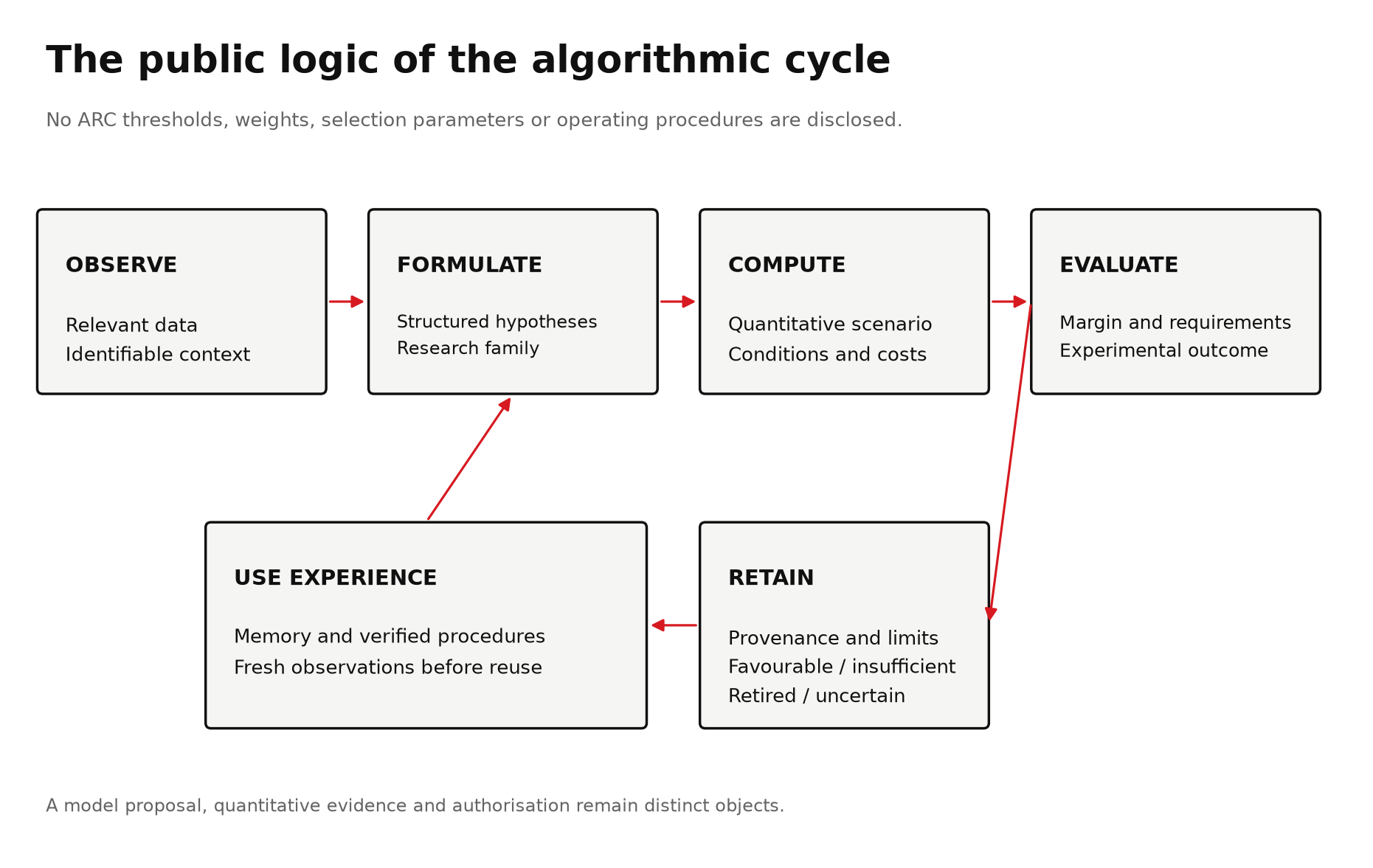
We can read the cycle as a series of transformations. At the input is a set of observations associated with a context. A family of hypotheses creates candidates; the laboratory represents them as scenarios that can be computed. The scenario’s economics are evaluated using the relevant costs. The result returns to the agent together with the conditions that give it meaning, before becoming part of retained experience.
The first transformation concerns the quality of the problem. The agent must understand which question can be answered with the available data and tools. A request for explanation, a historical comparison and a condition check are different tasks. Clarifying their meaning helps prevent a formally correct result from answering the wrong question.
The second transformation concerns the hypothesis’s form. An idea must be expressed in a language the laboratory can interpret. This makes it possible to separate the generative contribution from quantitative verification. The model can propose, while the engine applies the rules through which that proposal becomes an experiment. The architecture retains the connection without confusing the two responsibilities.
The third transformation is economic. The gross result is read alongside friction and scenario structure. A value means different things depending on whether it comes from a theoretical portfolio with open positions, a sequence of completed cycles or an incomplete observation. Evaluation must preserve these differences so that the number returned to the model retains the context that makes it usable.
The fourth transformation concerns knowledge. An experiment can leave favourable evidence, a more precise question or a reason to abandon a path. All these outcomes can be useful to subsequent work, provided the archive retains them in a recognisable form. This is where a research system can begin to become a system that uses its own experience.
The algorithm is therefore presented as a sequence of inputs, transformations and outputs, while proprietary detail remains within the product. This level is sufficient to understand the integration’s logic and assess its supporting evidence, without publishing the criteria by which Reinventy selects and operationally governs its candidates.
From the observed price to the margin that may remain
One of the most instructive distinctions concerns the relationship between an observed movement and the economic value that could remain after execution. For a proposal to be interesting, its initial advantage must survive the relevant costs. Fees, slippage, provider cost, gas and price impact belong to different categories; their incidence changes with the scenario’s path and scale.
A proportional fee grows with the value to which it is applied. A fixed cost, by contrast, weighs differently on a small operation and a larger one. Slippage describes a difference between the reference condition and the condition that can be obtained; impact considers that the operation itself can change the condition on which the forecast was based. Treating these items as a single undifferentiated percentage can hide why a candidate loses its appeal.
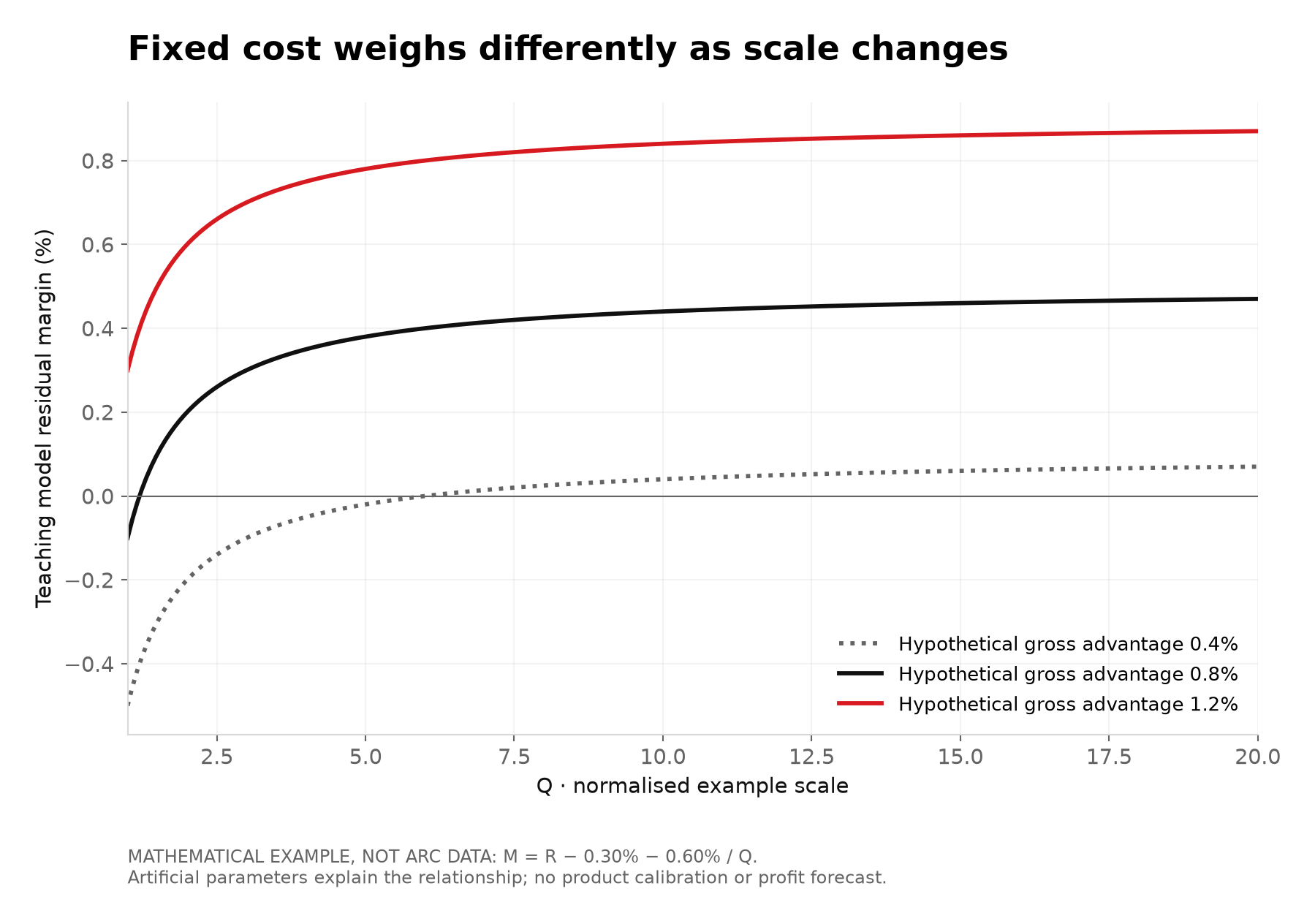
At the public level, the economic logic can be expressed simply: the conservative advantage is compared with the combined costs and the margin required by the research process. This relationship is central to the accompanying diagram. The formula shown is a general teaching model; the criteria by which ARC estimates, combines and selects its own candidates remain within the proprietary implementation.
What matters is the reasoning structure. A good directional forecast can produce a weak economic outcome because the movement is too small relative to friction. A more conservative proposal can become preferable when it retains margin after costs. A condition favourable at one scale may mean something different at another. Research must therefore examine a surface of possibilities rather than merely rank forecasts by nominal value.
The potential of an algorithm built this way also lies in the quality of its exclusions. Rejecting a fragile candidate before committing further resources can be as valuable as investigating a promising one. For the laboratory, that means better use of computing time and of the agent’s and people’s attention. For a future operational pathway, it means a stronger connection between what appears interesting and what deserves authorisation.
The geometry of costs makes the problem visible
A teaching example helps explain this relationship without exposing product calibration. Imagine an overall proportional cost and a fixed scenario cost. Residual margin then depends on the assumed gross advantage and the scale examined. The resulting curve makes clear that the same hypothesis can occupy economically different regions.
In the illustrative chart we chose artificial, declared values solely to represent the mathematical relationship. The region near the smallest scale is more affected by fixed cost. As scale increases, that cost weighs less in relative terms; proportional cost remains, as do all the other conditions the teaching model does not claim to describe. Any crossing above zero indicates only the margin’s sign within that example.
This reading avoids a common mistake: attributing a profit forecast to an economic diagram. A chart can instead help explain a dependency. It shows which question to ask the quantitative engine, which units to compare and which inputs make the result sensitive. The economic validity of a real candidate requires relevant data and conditions, beyond the shape of the curve.
Here the relationship between AI and algorithm becomes particularly productive. Tin Man can help explore the question, request comparisons, formulate variants and explain a difference. The calculation engine must return values obtained under defined rules and identifiable inputs. The agent’s text makes the result understandable; the calculation receipt allows it to be examined.
A product tutorial should reveal this reasoning architecture because it is an important part of the innovation. The ability to generate a hypothesis is placed within a system capable of examining its economic sustainability. It is a fundamental step towards an agent that improves its work without relying solely on persuasive language.
A numerical example: from gross advantage to residual margin
The chart can also be read through a complete calculation. In the example we choose a hypothetical gross advantage of 0.80%, a proportional cost of 0.30% and a fixed component that weighs 0.60% at the normalised scale Q equal to one. Q is only a teaching variable: it does not represent suggested capital or an ARC operational scale.
The illustrative model returns margin M by subtracting proportional cost and the fixed component divided by Q from the gross advantage. With Q equal to one, the calculation is 0.80% minus 0.30% minus 0.60%: margin is −0.10%. The hypothesis’s direction is favourable, but the model’s result remains negative. This is the simplest demonstration of why searching for movement and searching for margin are different problems.
With Q equal to five, the relative weight of the fixed component falls to 0.12%. The same example’s margin becomes 0.38%. At Q equal to ten, the fixed component weighs 0.06% and margin becomes 0.44%. The table allows readers to follow the calculation without attributing information to the curve that it does not contain.
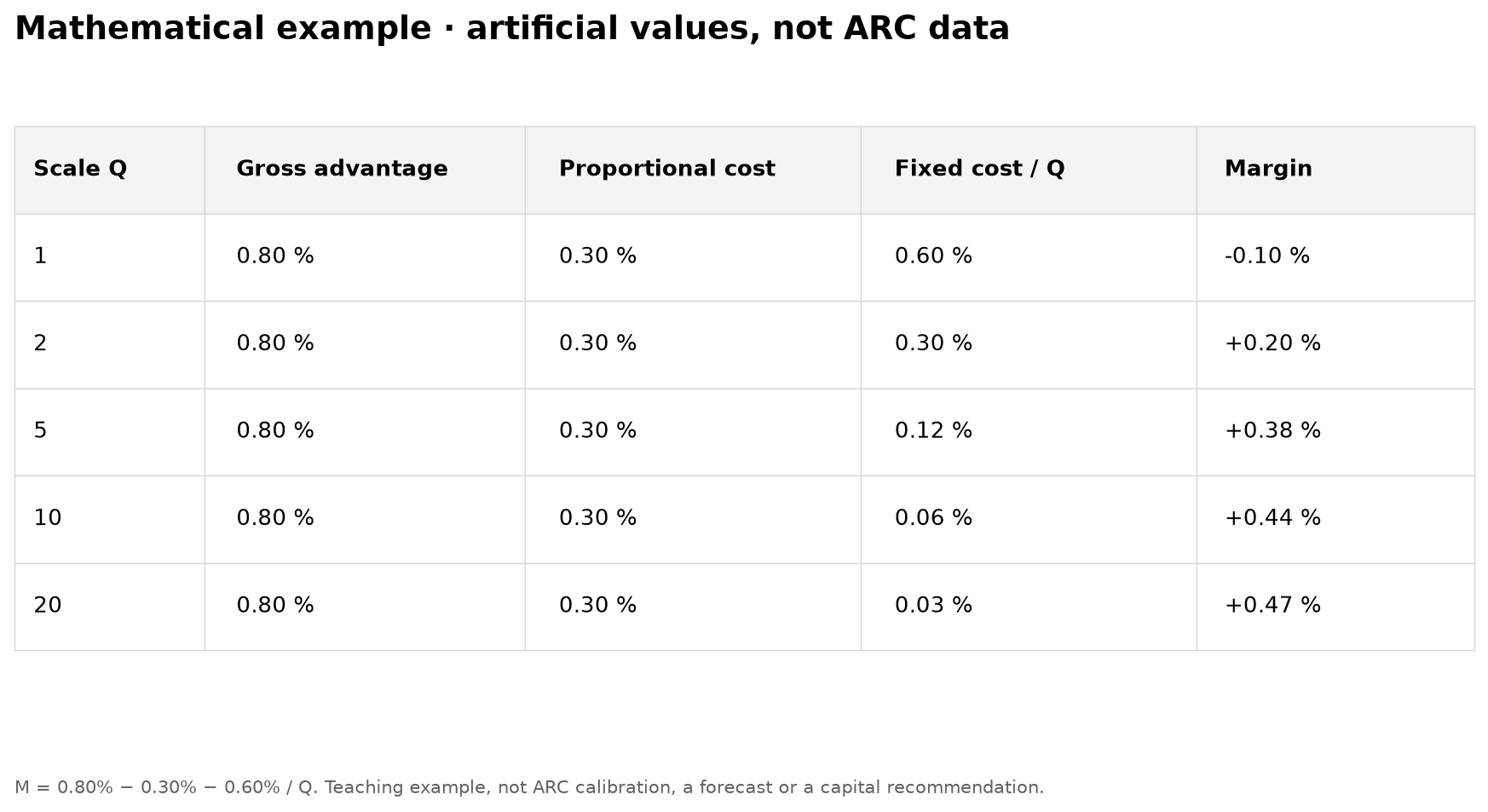
The result must be read within the chosen assumptions. The model holds proportional cost constant and does not represent increasing price impact or changing conditions with scale. In a real problem, those very phenomena can change the outcome. The diagram therefore does not justify concluding that increasing scale always improves a proposal’s economics; it illustrates the isolated effect of a normalised fixed component.
Breaking down the problem this way helps explain the algorithm’s role. An economic estimate acquires meaning when we know which quantities it includes, how they are expressed and which dependencies it represents. The quantitative engine must maintain those relationships; the agent can help users read them and recognise where a more complete experiment is needed.
Even the expression of percentages is part of precision. Moving from −0.10% to +0.38% means a difference of 0.48 percentage points in the illustrative model. It does not mean realised profit or describe a product measurement. Distinguishing a value, its unit and its scope supports stronger reasoning around the opportunities the laboratory seeks.
What makes integration a property of the product
There are models capable of writing analyses, tools capable of calculating indicators and infrastructures capable of collecting data. Reinventy’s choice is to organise them around a common working cycle in which a hypothesis’s provenance, economic evaluation and experimental result can remain connected. This integration is the characteristic we want to make distinctive in ARC.
Strong integration is recognisable when one component’s result becomes an understandable input to the next. A candidate must retain its identity as it moves from proposal to evaluation. A result must remain connected to the configuration that produced it. A revision must be distinguishable from its predecessor so that a parameter change does not implicitly rewrite the meaning of completed evidence.
This continuity can become the most valuable part. It allows comparison of the agent’s work over time, identification of useful experiments and construction of an experience base suited to system specialisation. The archive ceases to be a store of conversations and becomes research capital: observations, hypotheses, conditions, results and reasons why a path was retained or abandoned.
This industrial perspective matters deeply to us. An organisation’s competence also comes from remembering what it has verified, the mistakes it has recognised and the procedures it has learned to perform. Bringing some of that discipline into an agent opens the possibility of increasing work continuity as well as the speed of individual answers.
Our product thesis lies in this connection. ARC aims to combine an algorithm oriented towards scenario economics, a laboratory capable of multiplying hypotheses and specialist intelligence capable of using qualified experience. For Reinventy, the scale of this convergence is one of the strongest reasons to continue investing research and development in it.
The results that gave research a direction
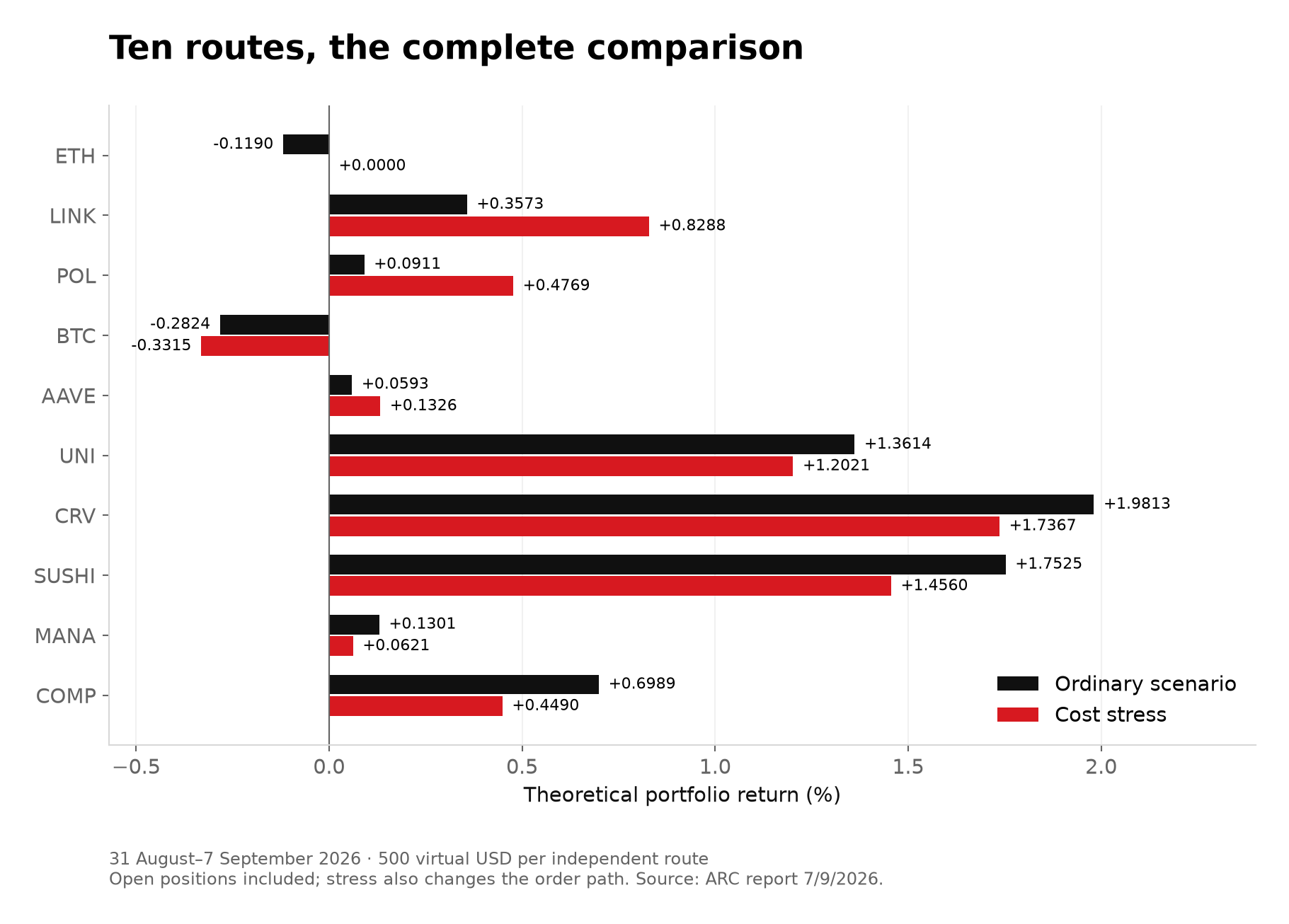
The historical comparison dated 7 September 2026 is one starting point for understanding why the project attracted interest. The replay considers a fixed window from 31 August at 06:42 UTC to 7 September at the same time. Each route has an independent theoretical portfolio of 500 USD; results include the value of positions still open and the costs specified by the model.
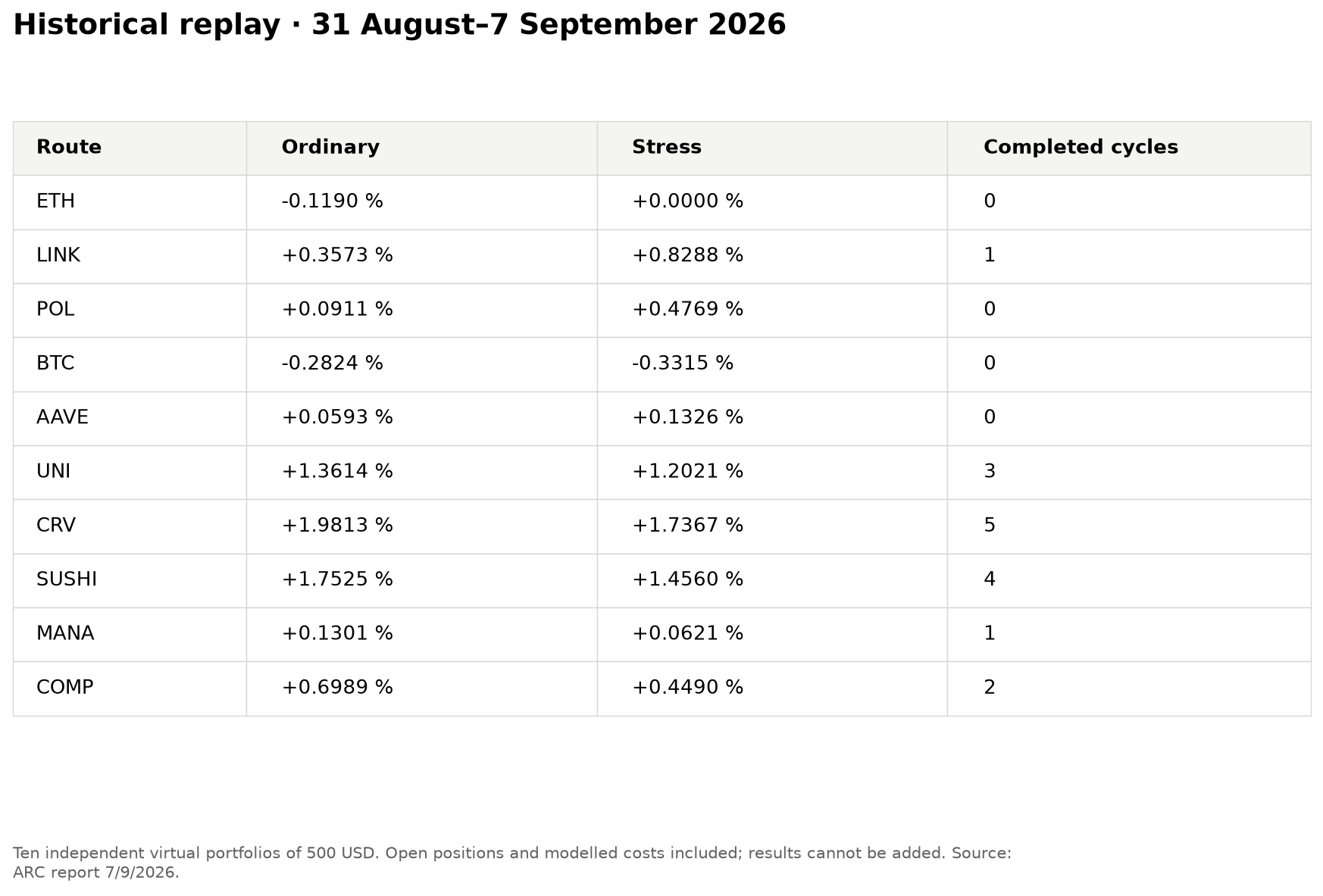
Overall, eight of the ten routes have a positive ordinary-scenario return. CRV reaches +1.9813%, SUSHI +1.7525% and UNI +1.3614%. LINK, POL, AAVE, MANA and COMP complete the positive group; ETH and BTC retain a negative result. The chart shows the entire set because understanding the project requires both favourable cases and those that raise harder questions.
The positive cases are a technological signal worth attention. They show that, under those experimental conditions, some hypotheses produced a favourable portfolio result after modelled costs. For Reinventy, they provide a concrete reason to investigate the algorithm, scenario selection and the contribution a specialist agent can make to the laboratory. The next step is progressively more demanding verification.
The table also retains completed cycles. This matters: the value of a portfolio with open positions and a set of closed cycles describe different aspects of the same experiment. Reading them side by side helps assess evidence maturity. The percentage becomes more informative when it remains connected to how it was produced.
The window is short and historical. We do not use it to annualise returns or declare realised profits; its strength is to reveal a phenomenon to study. ARC’s ambition is to build a system that enables that work with greater continuity, comparing scenarios, costs and new hypotheses within an examinable research history.
Reading a return table without losing the experiment
The first question concerns the unit of comparison. In this study each row is an independent portfolio. Ten starting amounts of 500 USD do not automatically constitute a single portfolio to which an average or sum of returns can be applied. Routes have their own histories, and the report retains the sample and cycle counts belonging to each.
The second question concerns what the result contains. A return including open positions also expresses a portfolio valuation at the end of the window. It does not necessarily equal realised profit. Pairing return with completed cycles can therefore help: the reader sees whether the result comes from a sequence that completed its path or includes exposures still present in the model.
The third question concerns comparison before and after a technical revision. The original report documents that most results remain unchanged. AAVE changes, but at the same time moves from one completed cycle to zero. That result alone does not demonstrate a substantial economic improvement across the whole system. It is an instructive example of how one metric can tell only part of the story.
Finally, time must be read as part of the experiment. A week is a window for observing behaviour, not a promise for the rest of the year. Scientific value grows when the question is asked again under separate conditions with retained data and rules. This is one reason archives and evidence identity play such important roles in the project.
These distinctions do not reduce the interest of favourable cases. They make it more precise. A laboratory capable of explaining why a result occurred can choose its next step better, allocate resources to the most instructive hypotheses and learn even from a change that initially seemed to be merely a better number.
Stress as a tool for understanding structure
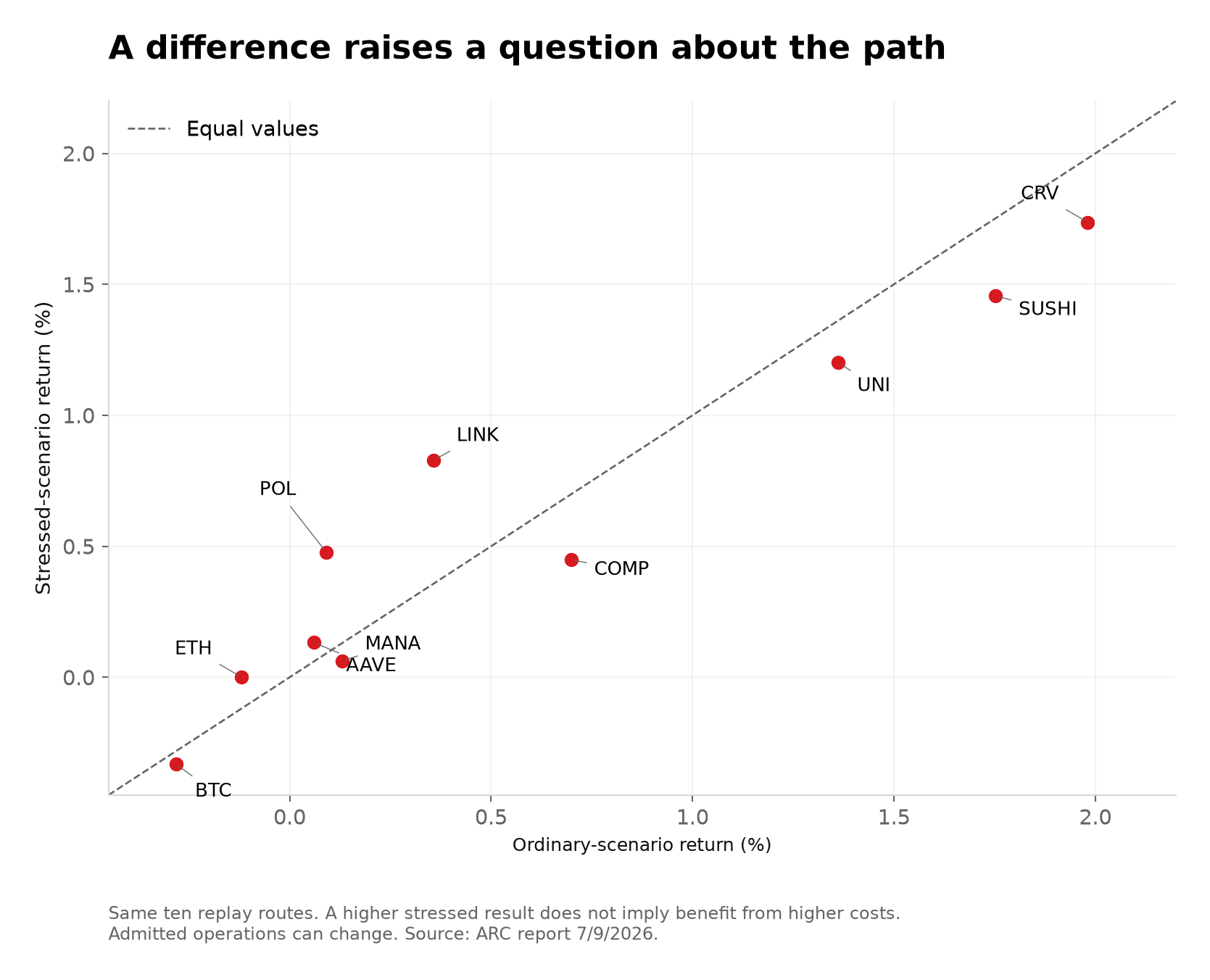
The available comparison also includes a cost-stress scenario. Its purpose is to examine model sensitivity: understand how the outcome changes when friction is represented more severely. The result can help distinguish an advantage retaining margin from one strongly dependent on initial conditions.
Reading it nevertheless requires another step. In the study, stress can also change which operations are admitted. The resulting sequence may therefore differ. If a route’s stressed return exceeds its ordinary return, the explanation is not that paying more creates value. The path may have changed: some operations are excluded, others remain and the portfolio’s entire evolution takes a different shape.
The comparison diagram uses the diagonal as a visual reference. Points on one side show a lower stressed result; those on the other show a higher one. The chart immediately raises a question, after which the experimental report must supply context. It illustrates how images and text can work together: the figure identifies a difference, while the narrative helps avoid attributing the wrong cause.
For a research agent, this is a crucial competence. A variation should prompt verification rather than immediately become a conclusion. The system can ask which inputs changed, whether cycle counts differ and which part of the outcome depends on path selection. Learning can then concern the mechanism that produced the result.
Here too lies industrial potential: improving the quality of questions the laboratory can formulate about its own results. An agent that helps examine differences methodically can turn a chart from a presentation element into a starting point for subsequent work.
Reading stability alongside return
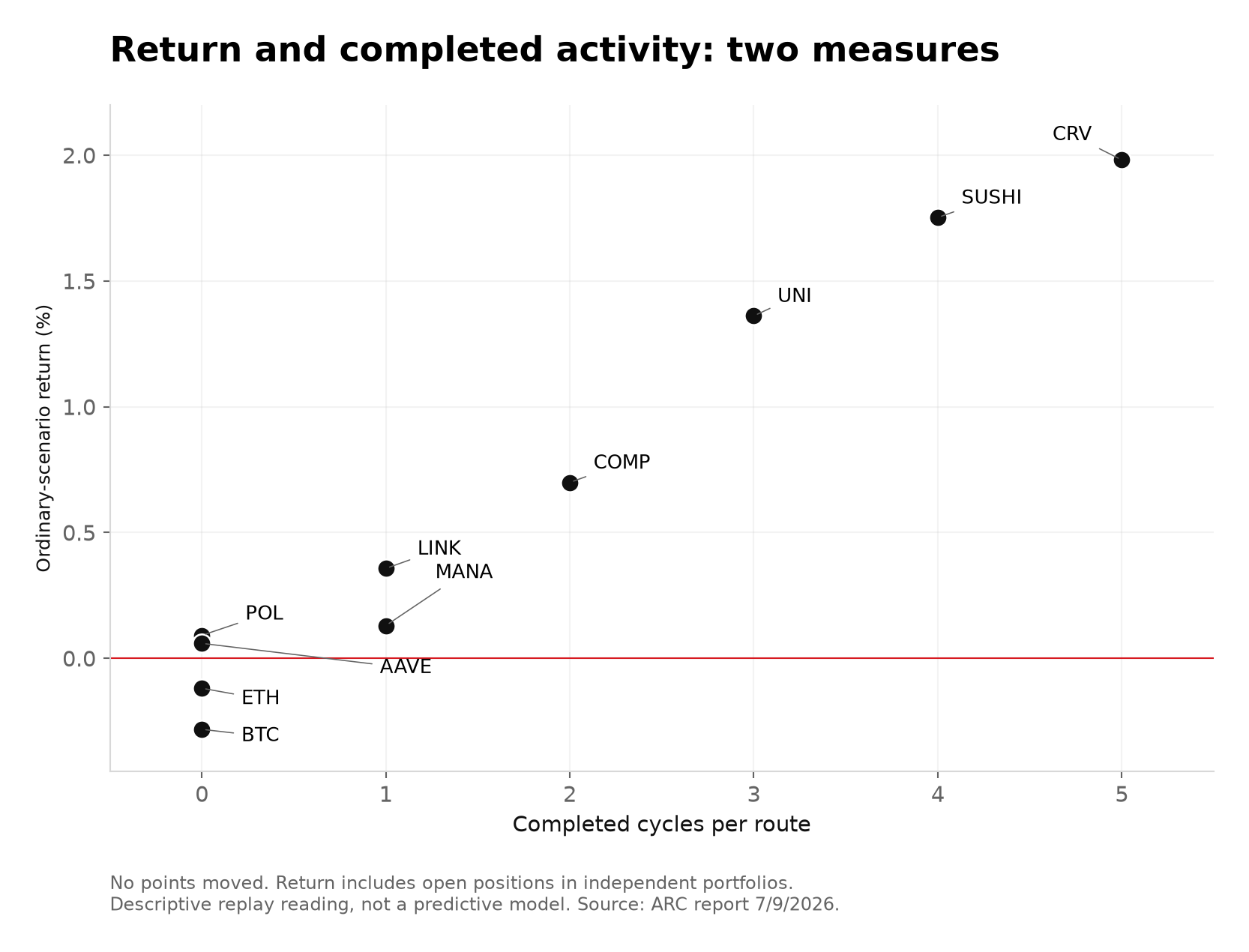
A positive percentage naturally attracts attention. Building competence, however, requires asking how that result is distributed over time and which conditions support it. The replay report retains negative days even for routes positive overall. This detail helps read return as the summary of a path rather than a uniform movement.
In the chart linking return and completed cycles, each point retains its route’s identity. The diagram does not create a predictive rule: it makes visible that portfolio results and completed activity can have different relationships. A route with zero completed cycles can retain a valuation result because the theoretical portfolio still contains open positions.
This reading is useful to the agent too. If the question concerns realising a result, a metric including open exposures requires a different context from a completed sequence. The quality of reasoning lies in choosing the measure relevant to the question while keeping other quantities available for interpretation.
A more complete research programme must therefore evaluate return alongside the conditions making it stable or fragile. The historical dossier does not allow every aspect of risk distribution to be reconstructed, and we do not use it to manufacture missing curves or statistics. Figures show only the measurements actually available or teaching examples identified as such.
The industrial outcome we seek is a richer reading of economic quality. A specialist agent can help organise it, provided the system maintains its connection to observations and experimental limits. This is another reason to seek the product’s value in the whole architecture.
IDRA: giving the algorithm a broader hypothesis space
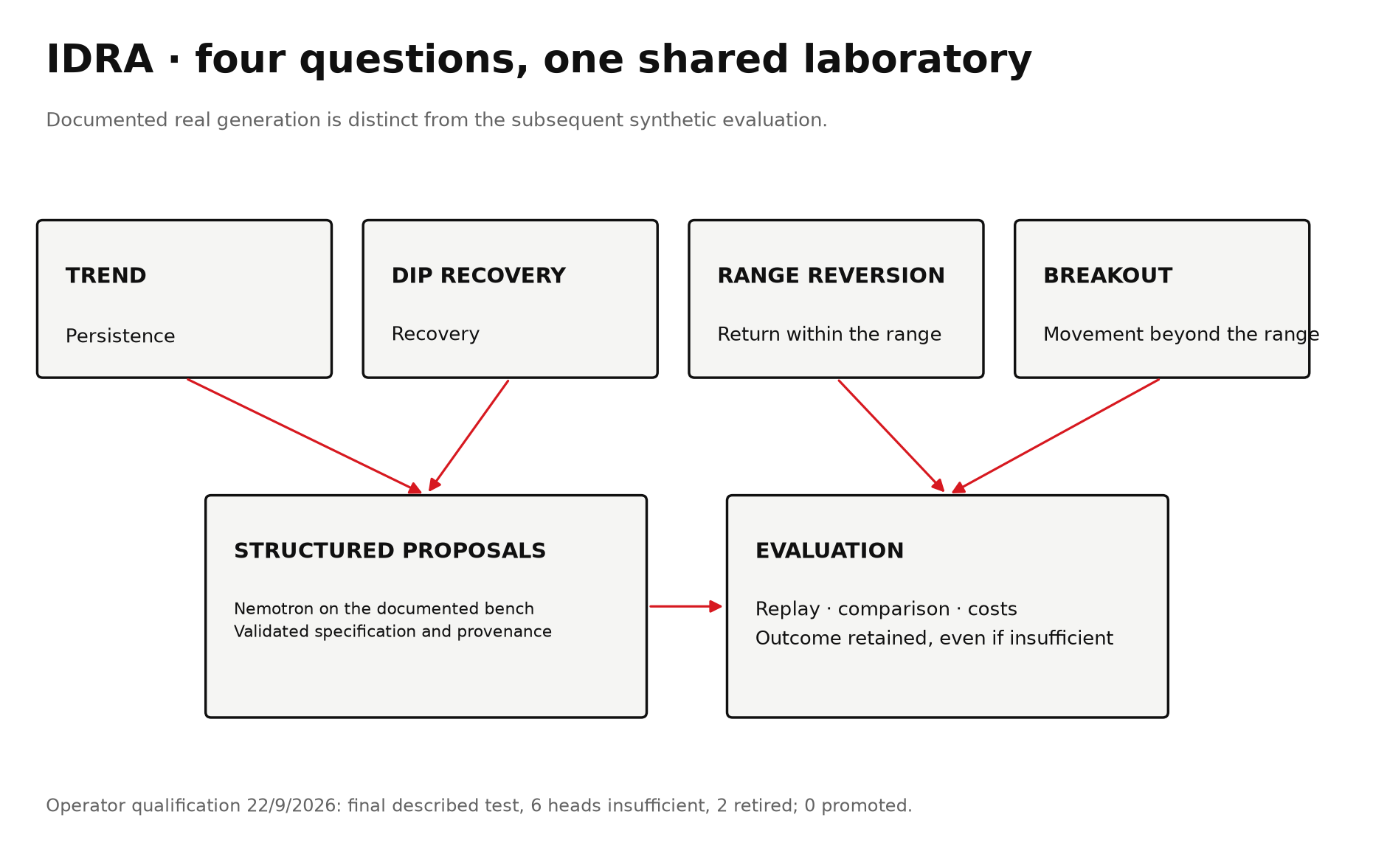
Quantitative research needs different hypotheses because a phenomenon cannot always be explained by the same structure. IDRA organises this space into four families: Trend, Dip Recovery, Range Reversion and Breakout. These are different ways of interrogating a phenomenon’s history and asking which behaviour might be interesting within an experiment.
Trend studies the persistence of a movement. Dip Recovery focuses on recovery after a decline. Range Reversion seeks a return within a range. Breakout examines movement beyond a previous range. Presenting them together explains the architecture’s function: each family brings a different question, and the laboratory must be able to compare proposals arising from different questions.
Nemotron’s generative contribution sits within this context. The model can propose structured variants that the system must then recognise and evaluate. Generation expands the research space, while the specification determines the form a proposal must take to be examined. Admission is based on correspondence between the candidate and the language the laboratory can verify, rather than the elegance of its explanation.
The diagram shows the public pathway: hypothesis families, proposals, structure checking, experiments and retention of outcomes. It does not expose proprietary parameters or how operating conditions are selected and sized. Instead, it reveals a fundamental choice: making model creativity compatible with experimental repeatability.
For ARC, this is a particularly important connection. The algorithm can benefit from new hypotheses, and the agent can benefit from a response richer than a simple textual judgement. It receives a history of evaluations, conditions and results from which to build reasoning more closely grounded in the work performed.
What the model actually did in the documented tests
The operator qualification dated 22 September 2026 distinguishes the product vision from a capability observed on a precise bench. It records two successful tests with a real Nemotron model: four requests per test and two heads per family. The model’s proposal was checked and admitted into the IDRA laboratory before the subsequent research replay.
This is a significant demonstration. The model produced structured objects that the software could recognise and use while retaining their connection to the request. Generative intelligence helped create computable research material, moving beyond the role of a commentator describing an already obtained result from the outside.
The subsequent replay was synthetic, however. In the final session described, two heads were retired and six remained with insufficient evidence; none was promoted. These outcomes also matter to the product narrative. They show that generation and evaluation retain different roles: a proposal can be formally valid yet lack sufficient evidence to advance.
Continuous availability, application transport for users and predictive capability require further verification. The operator report treats them separately. This scope helps interpret progress correctly: a concrete capability to generate proposals was observed in the qualified laboratory, without turning that result into financial authorisation or a profit measure.
The value Reinventy sees in this step is the possibility of building research increasingly assisted by specialist intelligence. A model producing structured proposals and an engine retaining their evidence can support a development cycle much richer than conversation alone. Future quality will depend on the discipline with which that cycle is extended and qualified.
Provenance is part of the system’s intelligence
When an agent produces a proposal, the system must know which request it belongs to, under which conditions it arose and which version evaluated it. This provenance is essential to interpreting a result. Two similar-looking objects can have very different histories: one may be an observed model response, the other test data prepared to check the software.
The documented laboratory retains this distinction. A declaration inside an object cannot turn a transport simulation into genuinely observed inference. Archive quality depends on this general principle: evidence origin must be connected to the process that produced it rather than relying solely on a description of its contents.
The same idea applies to time. A candidate can be relevant to a request and become unsuitable after context advances. A correct answer to an earlier question is not automatically valid for the current question. Managing this relationship is part of the engineering that enables the agent to operate within a system rather than merely within a sequence of messages.
This discipline becomes especially valuable when discussing learning. If the archive confuses synthetic and real data, assumed and observed responses, completed and uncertain results, subsequent specialisation inherits that confusion. If it preserves the differences, it can become a much more useful foundation for selecting examples, comparing procedures and building separate evaluations.
Part of ARC’s future competence will therefore depend on the quality of its documented past. This feature is less conspicuous than a brilliant model answer, but far more important for turning a successful experiment into a reusable asset. The archive retains the ability to understand why a path worked and when it is reasonable to try it again.
The next experiment must be able to surprise the system
A learning laboratory needs to encounter conditions that can challenge its conclusions. If the next experiment is designed only to rediscover what already worked, the archive risks accumulating confirmations of the same initial choice. More robust research retains the possibility that a new observation will change the judgement.
In ARC’s domain, this concerns both time windows and the relationship with costs and regimes. A hypothesis interesting in one sequence can behave differently elsewhere. A variant can look promising on one sample and lose its appeal in a separate examination. The laboratory must preserve the meaning of these comparisons because they can yield competence transferable to new situations.
Model learning requires similar discipline. The examples guiding adaptation should not exhaust the material used to judge the new version. Separate evaluation helps identify which capability was acquired and where errors or weaknesses remain. The specialist ARC programme must also be read through this question.
The agent’s role can be especially interesting in experiment formulation. It can help identify a difference to study, connect previous results and propose an alternative reading. Its contribution becomes more useful when the system retains the ability to reject the hypothesis and learn from the reason for rejection.
This is a form of scientific ambition that matters to us as much as product ambition. Intelligence that improves its laboratory can help seek better results. To assign value to that improvement, the laboratory must continue confronting evidence capable of disproving it.
Learning begins with experience worth retaining
Learning is where ARC’s outlook becomes most ambitious. A system performing many experiments can accumulate a large volume of results; the step forward lies in turning part of that work into usable experience. We must establish what to retain, with what meaning and under which conditions that knowledge can contribute to a subsequent decision.
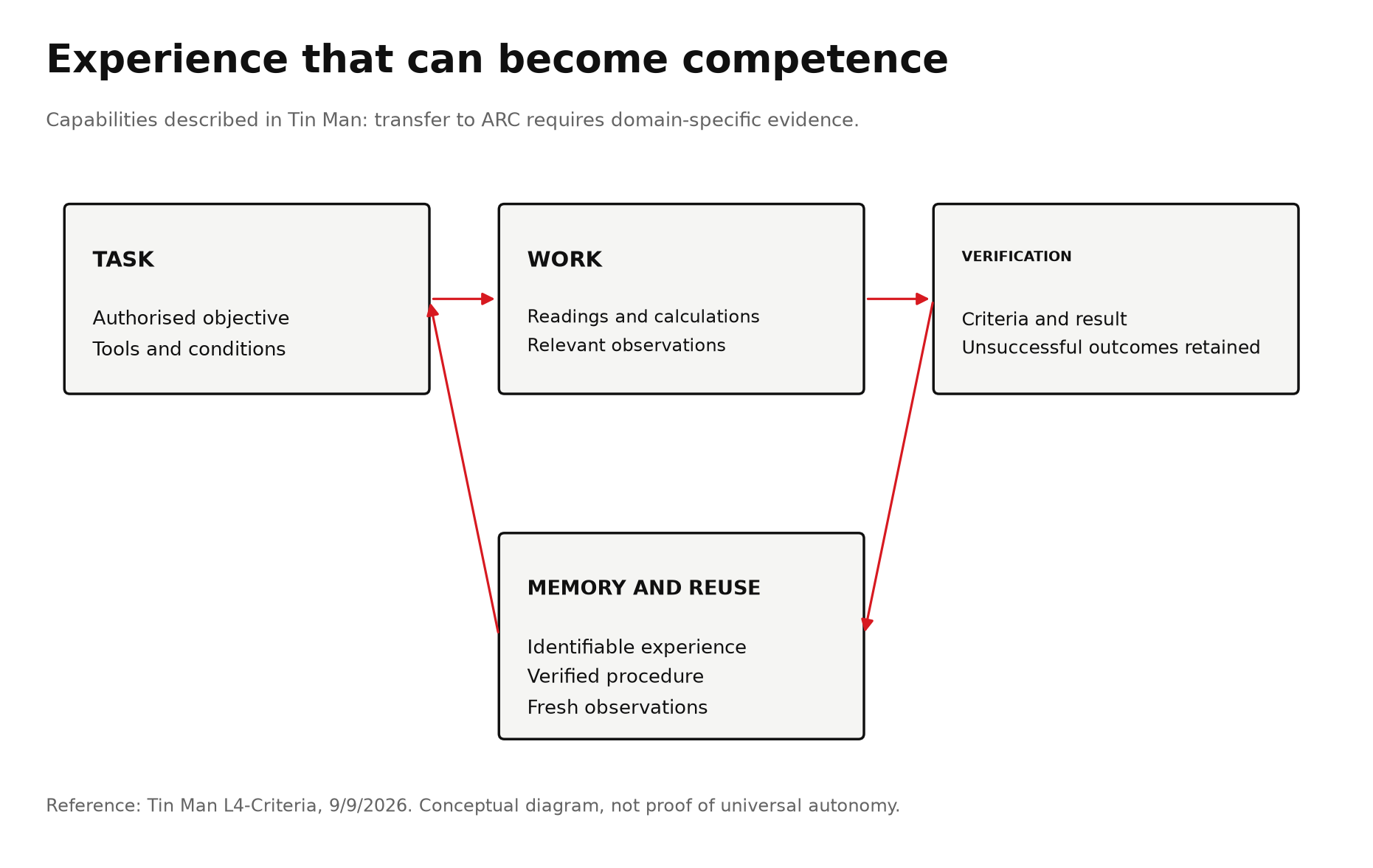
A conversation and a work episode have different structures. Hypotheses, explanations and revised reasoning can coexist in a conversation. A verifiable episode must instead maintain the connection between the assigned task, tools used, observations and the criterion by which the outcome was judged. Rich text can accompany this structure but cannot replace it.
Imagine the laboratory compared two scenarios and found an unexpected difference after costs changed. Useful experience includes the original question, comparison conditions and why the outcome was considered informative. Retaining only the concluding sentence would lose a decisive part of the work. Retaining the path too makes it possible to recognise a similar question and prepare fresh verification.
Within the Tin Man programme, the L4-Criteria documentation dated 9 September describes strategy reuse with fresh observations and retention of evidence even when a requirement is unmet. This is an important starting point for ARC’s domain. The competence we want to build must distinguish relevant success from apparent success, a useful procedure from coincidence and an incomplete result from a genuinely verified requirement.
This kind of learning has profound industrial potential. It can reduce wasted work, make checks more consistent and provide research continuity across many experiments. What grows is not merely the number of observations, but the ability to use what has already been understood more effectively while keeping verification open under new conditions.
Episodic memory: recognising a case’s meaning
Episodic memory concerns the history of an experience. For a research agent, an interesting episode might be a comparison, a failed reading, a hypothesis that did not reach a threshold or a procedure producing a verified result. Its value depends on the context that allows it to be interpreted.
An episode should not become a ready-made answer repeated unconditionally. If the agent recognises similarity to an earlier case, it can draw guidance for the work: which data to reread, which comparisons to prepare and which points may be sensitive. The result must nevertheless be reassessed against current observations. Memory helps choose a path; fresh evidence establishes what is true at that moment.
This is especially important for ARC because economic conditions change. A configuration yielding an interesting comparison in one window may lose that meaning elsewhere. A previously marginal cost can become decisive. An input once available may be missing. A competent agent must recognise a precedent’s value alongside the possibility that its outcome will not recur.
Well-organised memory can therefore retain the reason for failure too. If the cause was missing data, the laboratory learned something different from a measured hypothesis producing an unfavourable result. In the first case the question may remain open; in the second there is an observation to guide subsequent work.
This distinction becomes a cumulative asset. It allows greater value to be assigned to episodes with clear provenance and prevents persuasive narratives from replacing an experimental archive. It is one direction through which building ARC can turn research history into a methodological advantage.
Procedural memory: learning how to complete the work
Procedural memory concerns how a task is performed. For an agent it can mean retaining a verified working strategy: which steps are needed, which observations must be available and how to establish whether the requested result has been reached. This knowledge differs from simply remembering an event.
A teaching example makes the distinction immediate. Suppose a request asks for research sensitivity to a cost change to be checked. The agent must identify relevant scenarios, obtain results, compare like quantities and return a conclusion consistent with the data. A useful procedure retains this organisation alongside the conditions making it applicable. Each new use still requires fresh observations.
The Tin Man documentation also describes pure, bounded and tested comparison functions. In general terms, a pure function calculates a result from inputs without producing external effects. This separation is valuable: a condition can be evaluated without implicitly granting computation the power to perform an action. Reasoning can become richer while the boundary between evaluation and execution remains recognisable.
For ARC, the potential is clear. An agent making better use of verified procedures can standardise experimental interpretation, reduce methodological errors and devote more attention to differences genuinely deserving a new hypothesis. Process learning can contribute to laboratory productivity even before an improvement in an economic metric has been demonstrated.
A procedure’s value grows when we also know where it ceases to be relevant. A strategy should not be transferred to a domain, metric or tool for which it has not been qualified. This discipline allows competence to grow without confusing expanded memory with an automatic expansion of the agent’s powers.
A false requirement and missing data tell different stories
One of the most instructive checks in the Tin Man programme concerns the meaning of “verify”. Asking whether a condition is true and asking to complete an objective requiring that condition lead to different outcomes. In the first case, a false value can be a complete, correct answer. In the second, the work does not satisfy the requirement even though it may have produced valid observations.
Imagine a teaching bench with ten expected inputs and nine valid observations. To “are all available?” the answer is false. If the objective requires all to be available before proceeding, the requirement remains unmet. If instead the reading returns no acceptable set of observations, the very basis for that verdict is missing. These are three distinct conditions with different consequences for the agent’s work.
The L4-Criteria report connects this distinction to atomic evidence retention: observations, calculations and checks remain available even when the requirement is unmet. Failure is not turned into a successful strategy, and an effect already performed must not be repeated merely to try to obtain a more favourable conclusion.
Applied to economic research, this approach can become essential. A candidate excluded for missing data, one measured with a negative outcome and one still lacking sufficient evidence require different interpretations. The archive must retain these differences so that learning does not select only the most favourable account.
The ability to stop with a well-defined result is an important part of autonomy. It allows useful knowledge to be returned to the user even when the more ambitious objective was not achieved. A high-level agent must be able to organise this information, make it understandable and use its meaning in subsequent work.
From memory to the ARC model: two complementary transformations
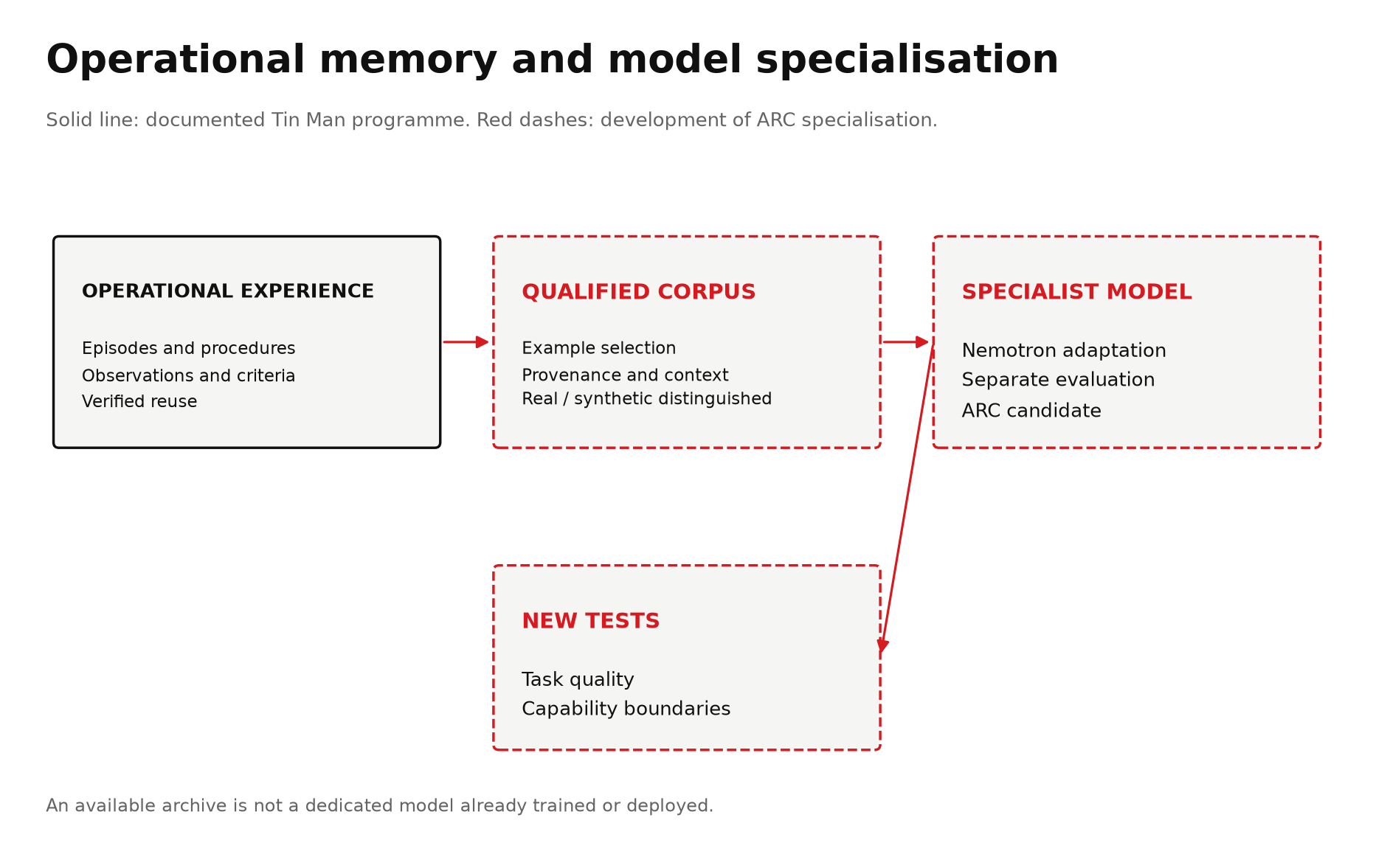
Operational memory and adaptation of a model’s weights are different mechanisms. The former retains and reuses identifiable experience; the latter aims to change model capabilities through a corpus and training process. The ARC programme envisages specialisation based on Nemotron, dedicated to the system’s domain and processes.
This outlook opens up work far beyond simply adding documents to a conversation. A specialist corpus must be selected, organised and evaluated according to the competences being developed. Domain language, interpretation of results, error recognition and tool use may require different examples. Quality also depends on how these examples represent capability boundaries.
An experimental archive can help build this material. It must distinguish observations from hypotheses, market data from synthetic scenarios and complete responses from unusable ones. Selection is part of learning engineering: increasing volume does not guarantee content becomes better suited to specialisation.
Evaluation must remain distinct from adaptation too. If the model is judged on the same cases that guided its construction, it becomes difficult to understand which competence transferred to new situations. The development programme therefore needs separate tests with a precise definition of expected results and acceptable limits. This is necessary to assign meaning to improvement.
The specialist ARC version and adaptation of its weights are developments in progress in the supplied material. Documented Tin Man capabilities provide a foundation, not proof that the entire vertical application is already deployed. The connection between operational experience, specialisation and evaluation is precisely what makes this direction so ambitious.
L4 as task continuity
In the Tin Man programme, L4 indicates a direction of autonomy within an authorised domain and mandate. The ambition is to receive an objective and manage a coherent path: plan, permitted tools, observations, evaluation and return of the outcome. Agent quality is measured through continuity of this work as well as the quality of local reasoning.
A complex task rarely amounts to a single model call. It can require several readings, comparisons and intermediate decisions. Some inputs may be missing, a service may stop and a response may arrive after context has changed. The agent must preserve the work’s identity through these conditions without losing its relationship to the limits authorising it.
For ARC, this means imagining intelligence capable of following an experiment, interpreting results and recognising the work still needed. It may include selecting relevant tools and reusing previously verified procedures. Preparing the specialist version must nevertheless establish which paths are actually qualified in the domain, rather than automatically transferring every capability from the general programme.
Continuity includes interruption. If a reading fails, the system must know it lacks a valid observation; if an operation has an uncertain outcome, uncertainty must be retained; if an effect has already occurred, it must not be duplicated. A useful resumption maintains task history instead of reconstructing it as though nothing happened.
This quality can profoundly change product value. An agent capable of completing identifiable work within a precise scope can become a much more dependable research collaborator. In this vision, autonomy grows alongside the ability to show where work stands and why it can or must continue.
The mandate belongs to the architecture
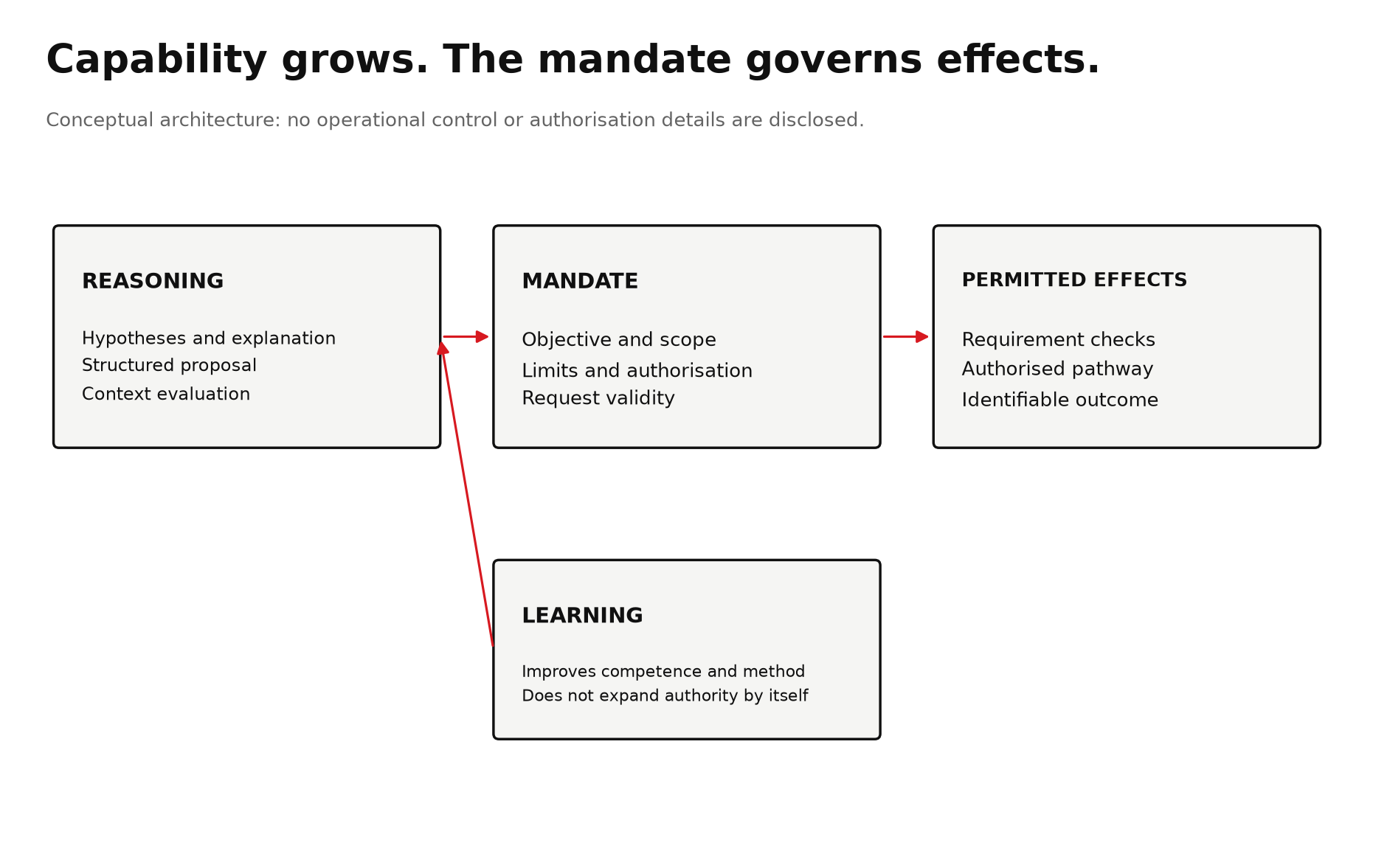
An agent that reasons better must continue operating under defined authority. In ARC, the mandate is part of the execution system: it connects the user’s objective to the scope of permitted effects. Model capability and power to act belong to different relationships that must be explicitly connected.
The industrial significance is immediate. A person may authorise research, a comparison or a particular kind of operation without authorising every effect the model considers useful to complete its explanation. The system must recognise this difference even when a proposal looks promising. Learning can improve tool use and domain understanding; it does not change the mandate by itself.
Project documentation also describes structured, signed documents linking identity, limits and authorisation. At the public level, the principle matters most: what is proposed must be comparable with what was authorised, keeping expiry and scope identifiable. Operational specifications and proprietary control details remain outside this editorial.
This relationship becomes more important when research generates variants. The model may expand the hypothesis space, but a variant does not acquire new powers because a more competent system produced it. Admission must continue distinguishing proposal quality from the authority needed to give it an effect.
For Reinventy, building this connection is part of product quality. It enables increasingly specialist intelligence while maintaining a readable relationship with user responsibility. It is necessary for envisioning an agent that can grow over time rather than a demonstration dependent on its developer’s constant presence.
Local computation changes the relationship with research assets
Tin Man’s outlook places reasoning within infrastructure controlled by Reinventy, using local models. The operator qualification cited documents real Nemotron use on the designated bench; the ARC programme proposes dedicated specialisation. This choice opens a different relationship with the corpus, model versions and experience accumulated by the system.
Local infrastructure’s value extends beyond available computing power. It also lies in governing the context in which inference occurs: which materials may enter the process, which version was used and how a capability is reassessed when models or tools change. Configuration control becomes part of result provenance.
In a specialist domain, this relationship can be particularly relevant. An archive of research, procedures and recognised errors can contain an important part of the industrial asset. Its usefulness grows when the organisation can manage access, selection and continuity while retaining its connection to the experiments that produced it.
Of course, local deployment alone does not demonstrate reasoning quality. An answer must still be judged within its task; a procedure must still be tested; a new model version must still be assessed against relevant requirements. Infrastructure sovereignty provides a governance context within which to build those checks.
For ARC, the direction is to unite these elements: research under Reinventy’s control, an agent increasingly familiar with the domain and a system capable of retaining the reasons for its results. Hardware, software, data and method contribute to the same industrial objective.
A complete pathway, explained from within
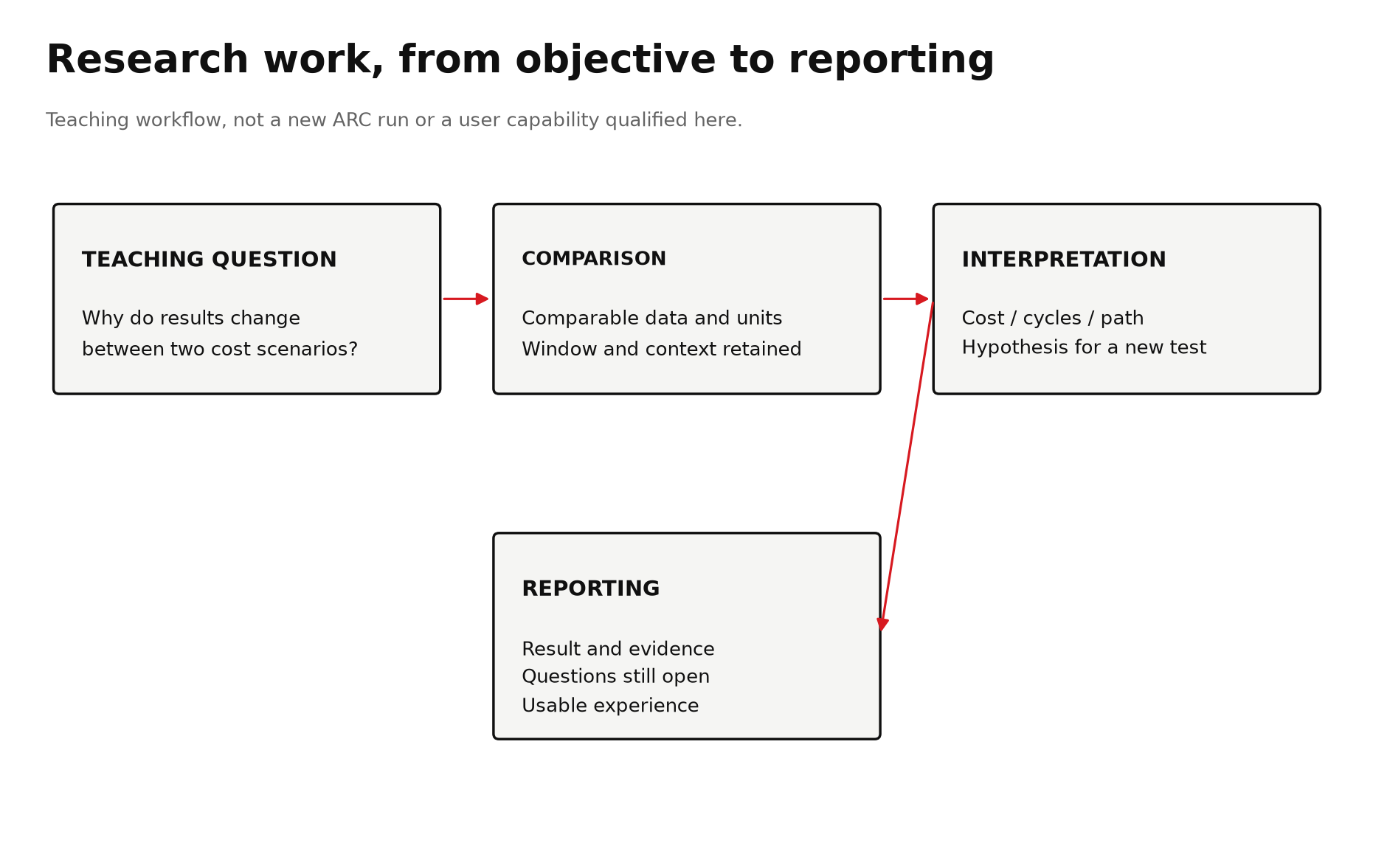
Consider a teaching example of the agent’s work. The request is to understand why a family of hypotheses produces very different results under two cost scenarios. The authorised task is comparative research; it does not include executing financial operations. This scope determines from the outset which tools and results are relevant.
Work begins by identifying the experiments. Before interpreting a difference, the agent must obtain results tied to identifiable conditions: window, configuration and units. If the scenarios are not comparable, discovering that incompatibility may itself be the first useful result. A complete answer must retain the reason.
When comparison is relevant, the quantitative engine returns the necessary quantities. The model can organise interpretation: distinguish cost components, observe cycle counts and ask whether the order path changed. A return difference is thereby turned into a question about mechanism rather than immediately becoming a judgement on strategy quality.
The agent can then formulate a further research hypothesis. Its value depends on connection to what was observed: which result motivates it and what the new experiment could verify must be clear. If the proposal requires tools or effects outside the mandate, the pathway does not introduce them implicitly. Continuing remains tied to available authority.
The conclusion returns work performed, observations and open questions. If the comparison met the requested requirement, the episode can contribute to verified procedures. If evidence is missing, the agent must retain that condition. The cycle’s value lies in the knowledge it leaves behind as well as the immediate result.
Response time belongs to the whole pathway
Discussions of AI often focus on how quickly a model generates an answer. In a system such as ARC, useful timing instead depends on several elements: observation availability, comparison execution, inference duration, context validity and when an eventual action might be admitted.
A quick response may rely on data already unsuitable. A slower comparison may be entirely relevant to historical research. A formally correct proposal may require a fresh observation before use in another context. These differences show why model latency and a proposal’s economic validity cannot be confused.
The system must therefore retain the work’s temporal meaning. Data age, experimental window and authorisation time describe different relationships. The public architecture can show them without exposing operational thresholds: each layer must know which context its decision belongs to and when fresh evidence is needed.
This is essential for learning. A strategy that worked in one temporal context must not be remembered as universally valid. Useful memory retains the conditions explaining applicability. Part of competence is recognising when a precedent is informative and when it requires a fresh check.
The specialist agent’s industrial ambition is to improve this coordination quality. The model can help interpret pathway complexity while the system maintains times, conditions and results in an assessable form. This is a deeper way to measure efficiency than conversation speed alone.
Three different questions for measuring progress
The first question is whether software does what its contract requires. Tests can verify that an out-of-specification response is rejected, provenance is not falsified or a late result is not applied to the wrong context. These checks are fundamental to infrastructure reliability, but their unit of measurement remains software behaviour.
The second question is whether the model performs the cognitive task on the designated bench. The IDRA report documents real generation of structured proposals; Tin Man L4-Criteria documents checks using the local model within observed tasks. These tests demonstrate specific capabilities and retain unsuccessful attempts too. They help establish which part of reasoning was actually exercised.
The third question is whether the entire pathway produces an economically repeatable result under conditions relevant to use. It requires different observations and methods. An exploratory historical replay can suggest a direction; new windows and cost verification can test it more severely. Hypothesis generation contributes to research, while the hypotheses’ economic value still needs measurement.
Reading these questions separately helps appreciate progress. A technical correction can matter even when historical returns remain nearly unchanged. A generative capability can be significant even when the heads produced retain insufficient evidence. A favourable result can deserve further work even when it does not yet constitute economic product qualification.
System maturity grows when these three dimensions are connected through understandable evidence. Part of ARC’s innovation therefore concerns how its own development is observed: the product must account both for capabilities acquired and for questions still open.
Available evidence and the frontier we are building
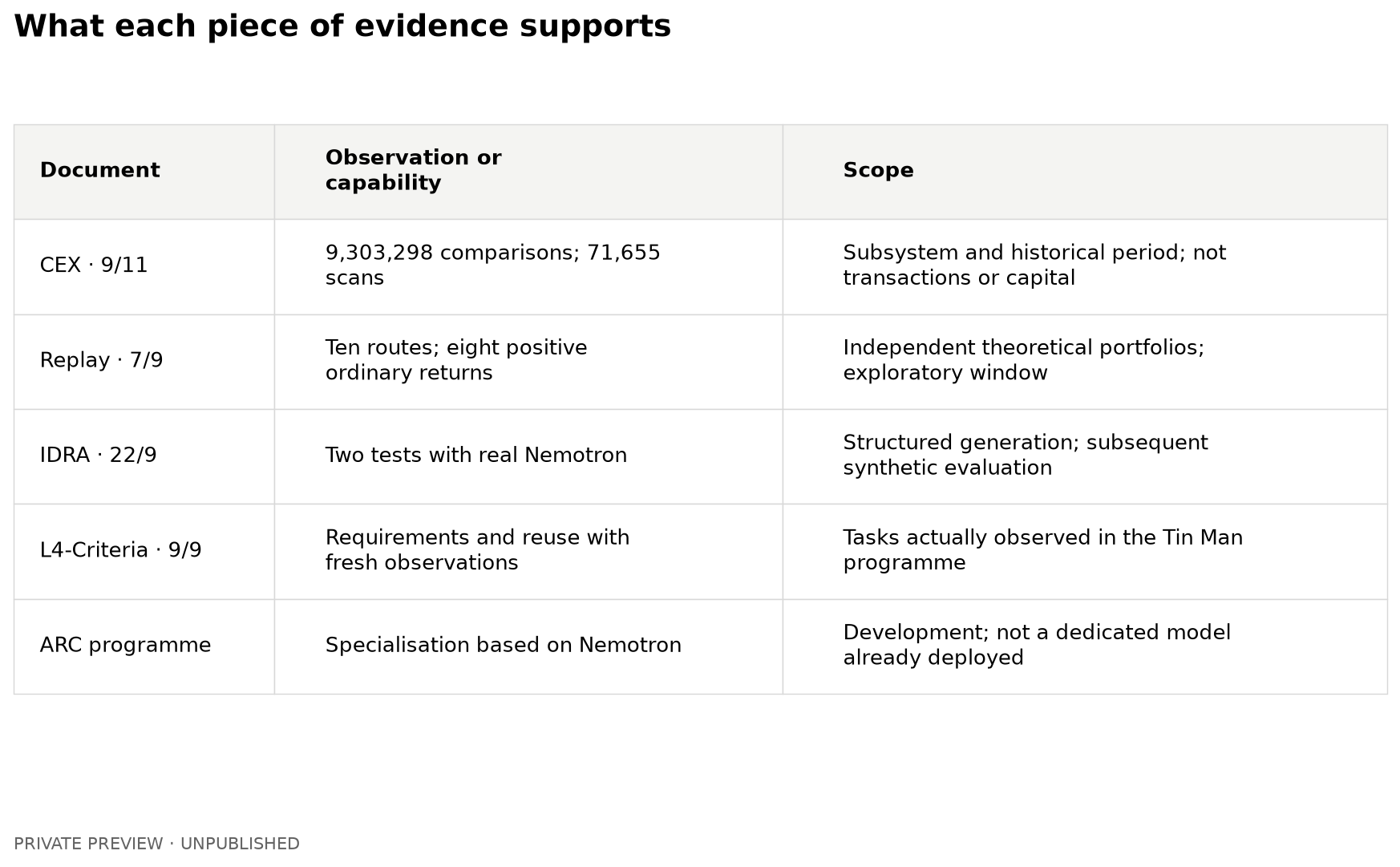
The documents present capabilities at different maturity levels. There is observed research activity in the CEX subsystem, exploratory historical replays, real hypothesis generation on the operator bench and criteria-management capabilities in the Tin Man programme. There is also the programme for a specialist ARC version based on Nemotron, aiming to integrate and deepen these competences within the domain.
This distinction matters to industrial work. A successful operator-bench connection has concrete value; moving it to an application service for users requires other contracts and evidence. Verified memory in Tin Man provides a foundation; its effectiveness on ARC tasks must be demonstrated within the relevant scope. A development ambition and an already observed capability play different roles in the product’s journey.
The evidence table helps readers orient themselves without losing the ambition’s thread. It shows which questions already have documented answers and which remain programme objectives. This way of presenting technology supports serious discussion of both present and potential value.
For Reinventy, ARC’s future lies in converging these lines of work into specialist intelligence capable of following economic tasks in greater depth. The model, algorithm and archive must become parts of a more competent pathway. New capabilities must bring evidence, applicability conditions and an examinable history.
This is an ambitious frontier. Potential profitability gives the project a powerful question; learning gives it a trajectory; method gives progress meaning. The product gains depth when these three dimensions grow together.
The economic potential of a learning laboratory
Profitability is one of the strongest questions ARC puts to its architecture. Positive historical results show cases in which the research model identified favourable behaviour within a defined window. Subsequent work must determine how much of that phenomenon can become repeatable, at what cost and through which selection process.
The potential Reinventy sees has several dimensions. There is the possible value of economically stronger hypotheses. There is the value of research rejecting fragile paths earlier. There is the value of an agent organising experiments better, reducing wasted work and making outcomes easier to interpret. These dimensions can contribute to the same product while requiring different measures.
A more productive laboratory can examine its possibility space more effectively. A better-qualified archive can help a specialist model recognise cases, errors and procedures. A more readable economic engine can connect agent discussion to verifiable conditions. Their convergence is why, in our eyes, the project has such broad significance.
Economic evidence nevertheless remains distinct from evidence of software capability. The historical report does not demonstrate current profitability, and real hypothesis generation does not demonstrate profit from the heads produced. The programme must earn that result through relevant experiments. Presenting these types of evidence separately values progress without attributing a measure it does not possess.
For us, the most ambitious prospect is ARC becoming a foundation for specialist economic competence: a system capable of searching, measuring and using experience better. This possibility deserves an account equal to its complexity. It is an objective requiring industrial ambition and quality of evidence to remain together.
Why knowledge capital may become the real advantage
A general model provides broad capabilities. A quantitative engine provides calculations and rules. A system’s qualified experience, by contrast, arises from the history of specific work. It can include how an organisation formulates questions, recognises errors, compares results and decides which procedures deserve reuse.
This history can become an asset difficult to reduce to a single feature. Its value depends on continuity: observations must be understandable, experiments identifiable, outcomes retained and procedures connected to supporting evidence. A specialist model can benefit from this asset only if its quality is maintained over time.
ARC is interesting precisely because it brings these themes into an economically demanding problem. The archive can help explain which conditions supported a result, which reasoning was useful and which hypothesis needs further evidence. Competence grows when the system uses these distinctions to organise future work better.
The distinction Reinventy intends to develop lies in proprietary integration of algorithm, laboratory and agent. It is a precise industrial choice: building intelligence with an increasingly deep relationship to the method and experience of its domain. Product specificity comes from how this architecture is implemented, verified and developed over time.
For members, shareholders and partners, this is central to the outlook. Potential value is not confined to one route’s result. It concerns developing a system progressively more useful at formulating problems, examining opportunities and retaining knowledge. Here, research into an algorithm begins to become research into a new organisational capability.
A product that can become a foundation
The most interesting prospect is ARC becoming a working foundation on which to build specialist competence beyond individual features. An environment connecting observations, hypotheses, calculations, memory and authority can enable more orderly evolution: each new capability enters a history retaining its origin and meaning.
This also changes how value over time is imagined. A favourable result can motivate a tougher experiment. A verified procedure can contribute to a new agent competence. A curated archive can provide material for model specialisation. Knowledge produced through work thus becomes a resource for subsequent work.
This is where Reinventy sees a far-reaching prospect. Artificial intelligence can enter the front line of research, helping formulate and connect problems with real economic consequences. The algorithm gives it measurable ground; experience can give it depth; the mandate maintains its relationship to the authority permitting action.
Our ambition is to build this convergence. Positive cases already observed justify the energy we are devoting to the project. The decisive step will be turning part of those results into increasingly repeatable competence capable of facing new conditions. For us, this is one of the most demanding and stimulating applications of Tin Man architecture.
Sources, images and the scope of this dossier
Replay measurements come from the ARC report dated 7 September 2026 and concern the 31 August–7 September window, with 500 virtual USD per independent route. The CEX counter is the historical extract dated 9 November, referring to the period beginning 8 October. Nemotron generation is documented in the IDRA operator qualification dated 22 September. Requirement-evaluation and reuse capabilities cited in the text come from the Tin Man L4-Criteria report dated 9 September.
These documents describe defined tests and periods. Replays are exploratory, not out-of-sample results or demonstrated current profitability; returns include open positions and modelled costs. Past or simulated performance does not guarantee future results. The specialist ARC version and adaptation of its weights remain a development programme in the supplied material.
The cover is an AI-generated conceptual illustration created for this editorial. Diagrams represent the public architecture and development path without revealing proprietary calibration. Replay charts use all ten available results. The cost chart is a mathematical teaching example with declared artificial values, distinct from ARC results. No capital curves, price series or risk statistics missing from the sources have been reconstructed.