
Peregrine X: Where Reinventy Technologies Take Flight
· By Antonio Sedino, CTRO · Published by Reinventy Solutions Corp.
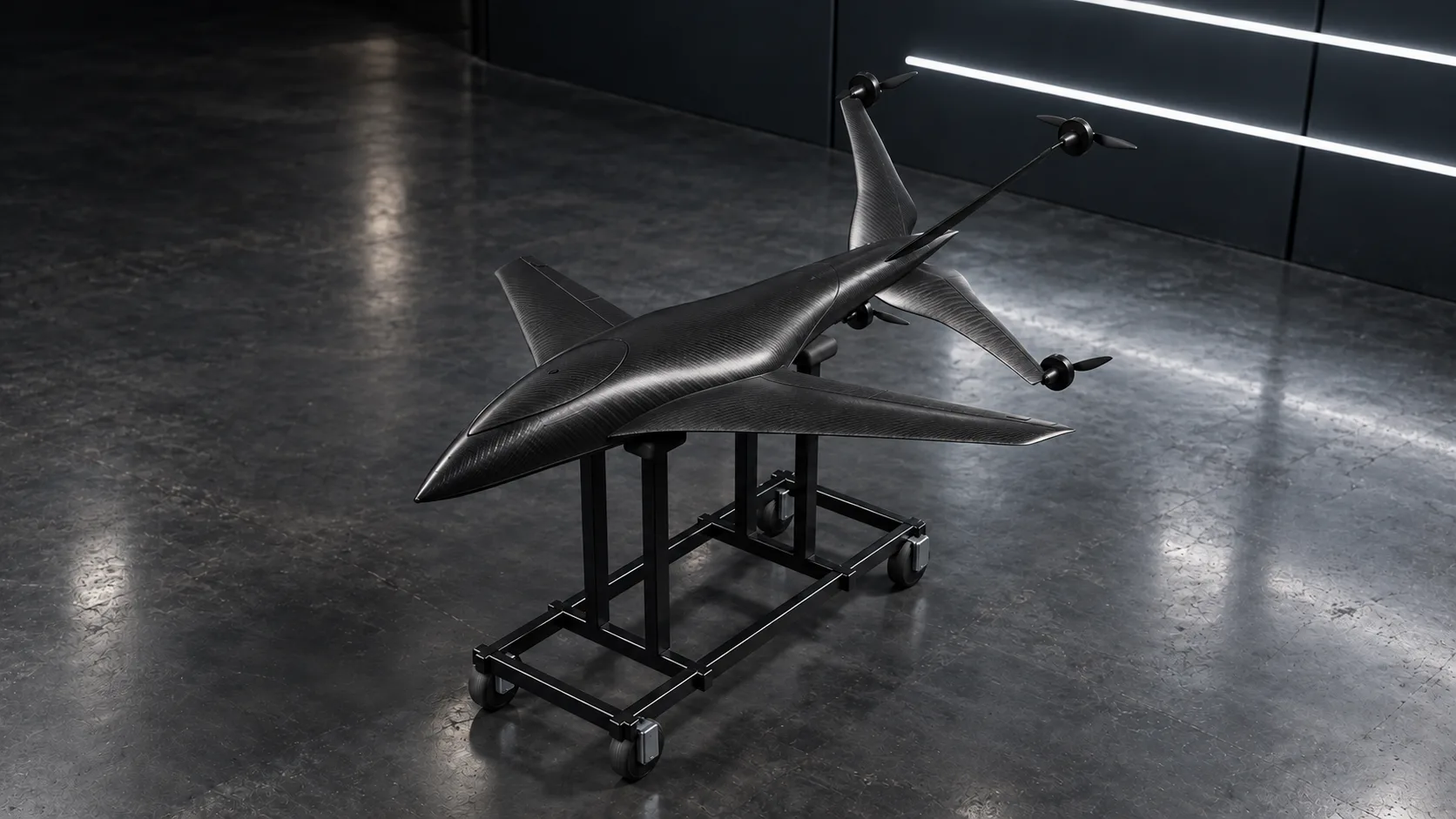
When I speak about Peregrine X, I am not thinking only about an aircraft. I am thinking about the point at which Reinventy technologies must come together, work together and prove themselves in the physical world.
An advanced material, a propulsion system, onboard intelligence or a protected control chain can each have value in isolation. The more demanding challenge begins when we ask them to operate as one system. That is the purpose of the Peregrine X programme: to take the Reinventy ecosystem into the air, connecting structure, energy, perception, decision-making and motion.
To me, that is what a technology demonstrator is for. Not to display a collection of technologies, but to establish whether, together, they can deliver a useful capability.
Vertical access. Wing-borne reach.
Peregrine X is a hybrid VTOL airborne demonstrator programme, combining vertical take-off and landing with wing-borne flight. Here, “hybrid” describes the flight configuration; the intended propulsion pathway is electric.
The configuration presented features four dedicated lift motors. The objective is to combine access to locations where a runway is unavailable with the efficiency of wing-borne flight during transit. Rather than remaining in energy-intensive hover throughout a mission, the aircraft is intended to use different flight modes for different operational needs.
The programme has clear performance targets: a maximum speed of up to 250 km/h, a range of more than 150 km, and a target payload of 2–10 kg, depending on configuration. The planned battery configuration is 14S.
These are programme objectives, not certified performance figures. Speed, range and payload will depend on the configuration and mission profile; the maximum values should not be interpreted as simultaneously guaranteed. Testing will establish the actual operating envelope.
Intelligence must translate into controlled motion
At the centre of the Peregrine X vision is the cognitive pilot. Tin Man and Shield Brain provide the pathway towards onboard perception, sensor fusion and mission reasoning. The objective is not simply to execute a sequence of commands, but to help interpret the operating environment, support the mission and monitor the health of the system.
That intelligence must translate into controlled physical behaviour. This is where Phantom-Core and Reinventy Shield enter the programme: connecting cognitive decisions to governed autonomy, with explicit operating limits, safety boundaries and human authority.
Sentinel-Link addresses the protected actuation layer, carrying authenticated commands through the chain that connects decisions to movement. This is an essential relationship. A system capable of reasoning must also be able to act within defined, verifiable conditions.
For that reason, I see synthetic piloting as a capability to be integrated and qualified within the aircraft—not as a label attached to it.
Materials are part of the same mission
Peregrine X is also intended to bring Reinventy’s materials and protection technologies into the same programme. Revenant and XHT provide the integration pathway for structural composites and thermal-protection materials. NanoShelter contributes the protection layer for critical onboard electronics, energy and mission systems.
AeroMag and Mag-FOC represent the pathway for electric propulsion and deterministic motor control across the different phases of flight.
These layers are not independent. Material choices affect system requirements. Available energy constrains the mission. Propulsion must respond to commands, while onboard intelligence must operate within the platform’s physical limits. The demonstrator exists to test those relationships as a whole.
That is the distinction I want to make clear: Peregrine X is not an aircraft carrying a list of Reinventy technologies. It is the programme in which those technologies are intended to function as an integrated capability.
One platform, different mission possibilities
The planned capabilities support potential applications in sensing, mapping, inspection and research. Vertical deployment, wing-borne transit and configurable payload carriage can provide a basis for carrying sensors and instruments selected for a particular task.
I do not see Peregrine X as an indiscriminate answer to every operational requirement. Its value will lie in matching a configuration to a defined mission—and demonstrating that the complete system can carry it out under specified conditions.
The same principle guides SES-34 at sea. Different environments, different demonstrator programmes, but a shared ambition: to bring Reinventy technologies together in platforms where every layer contributes to the overall result.
Demonstration matters more than promise
This is how I want Peregrine X to be understood: as the programme in which our technology ecosystem is called upon to perform together. The integrations are not all qualified, and flight performance remains to be measured. Being explicit about that makes our commitment more precise.
The question that matters is not simply how fast Peregrine X will fly. It is whether materials, intelligence, protection and propulsion can work together to perform a useful mission, with control and accountability.
For me, Peregrine X represents the move from individual technologies to a working system. That is where we intend to take Reinventy.
Antonio Sedino