
SES-34: Where Reinventy Technologies Become Naval Autonomy
· By Antonio Sedino, CTRO · Published by Reinventy Solutions Corp.
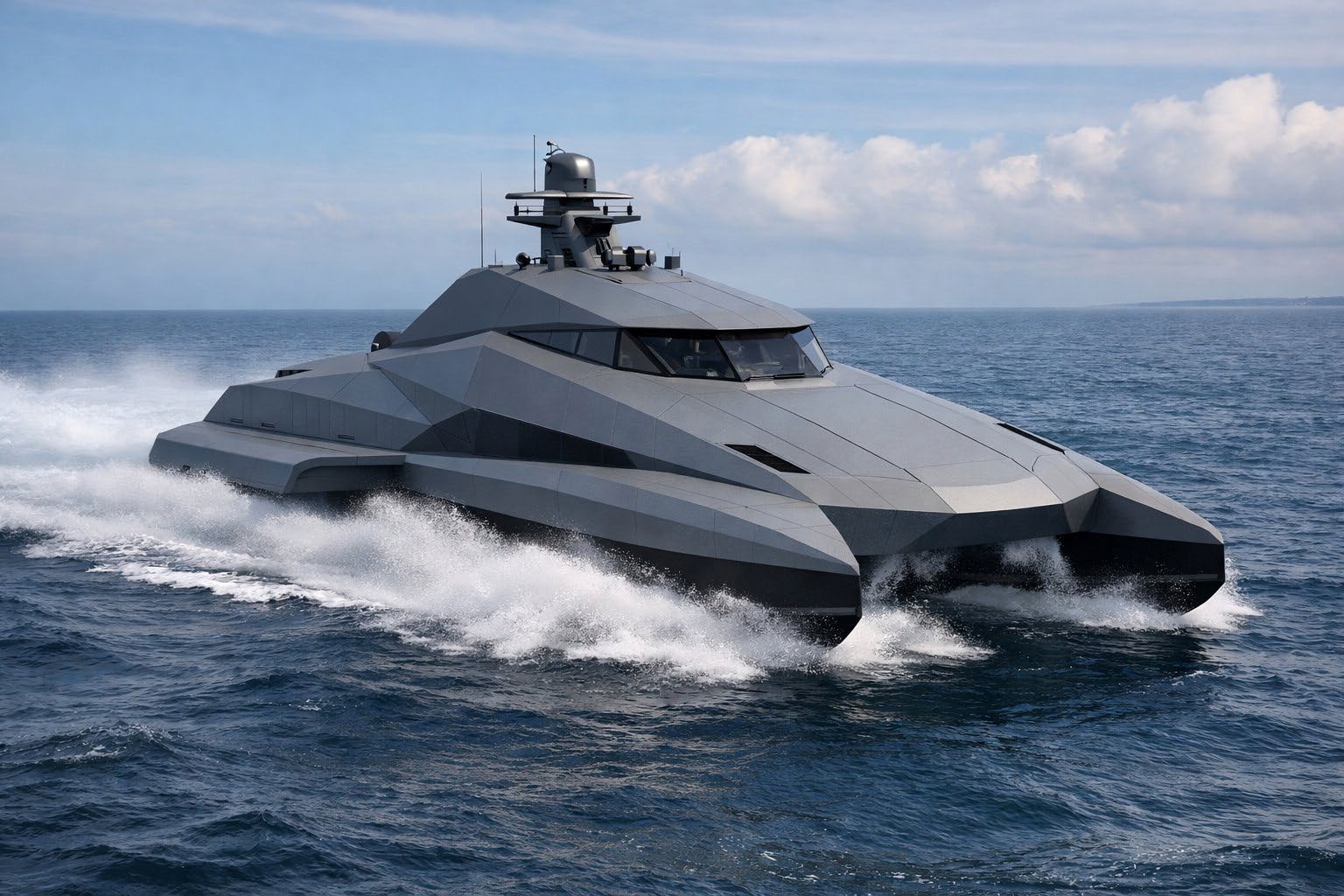
From advanced materials and electric motion to Tin Man, the synthetic pilot: SES-34 brings Reinventy’s technology programmes into a shared maritime architecture. A closer look at the platform, its integrated aerial perspective and the engineering path from concept to dependable autonomy.
From flight to the sea: the next chapter of an integrated vision
In our previous weekly editorial, Peregrine X provided a way to explain what happens when Reinventy technologies meet inside an aircraft. This week, we take that same question to the sea. The SES-34 is another expression of the ambition behind our work: to bring materials, protection, electric motion and synthetic intelligence together as parts of a coherent physical system.
What makes this project interesting is more than its silhouette. It is the relationship between the machine and the intelligence intended to operate it. A vessel must move through an environment that changes continuously. Waves alter its behaviour. Weather changes its options. Energy availability constrains its actions. Equipment condition affects what it can safely attempt. Naval autonomy has to work inside those realities, rather than treating the vessel as an abstract vehicle on a digital map.
That is why I see the SES-34 as a convergence platform. It gives Reinventy's technology programmes a shared engineering problem: how to build a maritime system that can perceive its surroundings, understand its own condition and pursue an authorised objective while remaining accountable to human direction.
A surface-effect platform with a different operating logic
SES stands for Surface Effect Ship. The concept uses an air cushion contained between lateral hulls, working with the vessel's structure and propulsion to change how the platform interacts with the water. The SES-34 engineering programme combines this approach with waterjet propulsion and an unmanned architecture.
The purpose is to develop a platform that can combine rapid transit with persistent operation and useful manoeuvrability. Those objectives depend on the complete system: hull geometry, cushion behaviour, installed power, mass distribution, control and the conditions at sea. A render cannot demonstrate them. They must emerge from engineering analysis, integration and physical testing.
The absence of an onboard crew also changes the design question. Space and systems are organised around the platform's mission, equipment and maintenance requirements. But removing the crew does not remove responsibility. It moves more of the operational burden into sensing, control, communications, supervision and the ability to recognise when the machine should reduce its ambition or return to a safe condition.
Tin Man: a synthetic pilot that must understand the machine
The SES-34 programme connects naval autonomy to the cognitive architecture presented publicly as Tin Man and Shield Brain. The central idea is a synthetic pilot whose role extends beyond following a route. Its intended responsibilities span perception, interpretation, operational memory, planning and the use of authorised tools within defined boundaries.
Consider an instruction to reach an area and maintain observation. A conventional navigation function can describe a path. A cognitive pilot has a wider problem: interpreting the objective, retaining its context, relating incoming information to what is already known, considering the platform's available resources and proposing or executing actions that remain within the operator's instructions.
That distinction matters at sea. A technically possible action may become inappropriate as conditions change. A useful observation may require a different position. A developing equipment issue may make continuation unreasonable. Intelligence becomes operationally valuable when it can connect these facts to the machine's actual capabilities and constraints.
The intended relationship is therefore between an operator, an authorised objective and a governed synthetic pilot. Human authority remains explicit. Local cognitive operation is an architectural aim that can reduce dependence on a continuous remote reasoning service; it does not eliminate the need for supervision, suitable communications or carefully defined procedures when information or connectivity becomes unavailable.
Cognition above control, not in place of it
A vessel cannot depend on a language model improvising the behaviour of its motors. The SES-34 integration approach separates cognitive decisions from the control functions that make physical action dependable. Tin Man belongs to the layer that interprets context and objectives. Lower-level controllers remain responsible for enforcing the operating constraints of the equipment they command.
This is where Mag-FOC enters the story alongside AeroMag electric-machine development. Field-oriented control concerns the controlled operation of electric motors. Cognitive planning concerns what the platform should try to accomplish. Their integration must preserve the distinction between deciding on an action and delivering that action through predictable, constrained physical control.
For the reader, the practical consequence is simple: autonomy is a chain. Perception must inform a decision; the decision must pass through permissions and physical limits; the command must reach suitable control hardware; feedback must show what actually happened. If one link is weak, an impressive reasoning demonstration does not become reliable naval operation.
The material platform is part of the intelligence platform
It is tempting to describe an autonomous vessel as a hull with software added. The technical integration work behind SES-34 takes a broader view. The structure, protective systems and electric machinery shape the conditions in which its synthetic pilot can operate.
XHT is considered for components exposed to demanding thermal conditions, with monitoring concepts intended to make physical condition part of the information available to the system. Revenant is developed as a structural skin concept rather than a purely decorative surface. NanoShelter brings a layered approach to protecting critical equipment against different environmental and electromagnetic stresses.
These programmes have distinct jobs. They should not be flattened into a claim that one material solves every problem. Their value lies in how the functions fit together: protecting a critical compartment, supporting the platform's structural requirements, managing exposure and making degradation easier to detect and respond to.
The same logic applies to propulsion. AeroMag and Mag-FOC address different parts of electric motion: the machine and its control. Together with the material and protection programmes, they form the physical foundation on which higher-level autonomy depends. Reinventy's ambition is integration with traceable interfaces, rather than a list of technologies assembled for a presentation.
Energy is an operational decision, not an unlimited resource
The engineering baseline considers hybrid-electric architecture. Electric propulsion should not be confused with a claim that the complete vessel operates exclusively from batteries. Generation, distribution, storage, power conversion and thermal management each have roles in sustaining operation.
This architecture also makes energy management inseparable from mission management. Propulsion, onboard computation, sensors, auxiliary systems and an integrated aerial capability compete for resources. A plan that ignores those demands is incomplete, however sophisticated its reasoning appears.
The synthetic pilot's intended task is to operate with an understanding of the available envelope, while dedicated control and protection systems enforce equipment limits. The larger engineering objective is to connect decisions to consequences: what an action consumes, what condition it creates and what options remain afterwards.
An aerial perspective that belongs to the maritime system
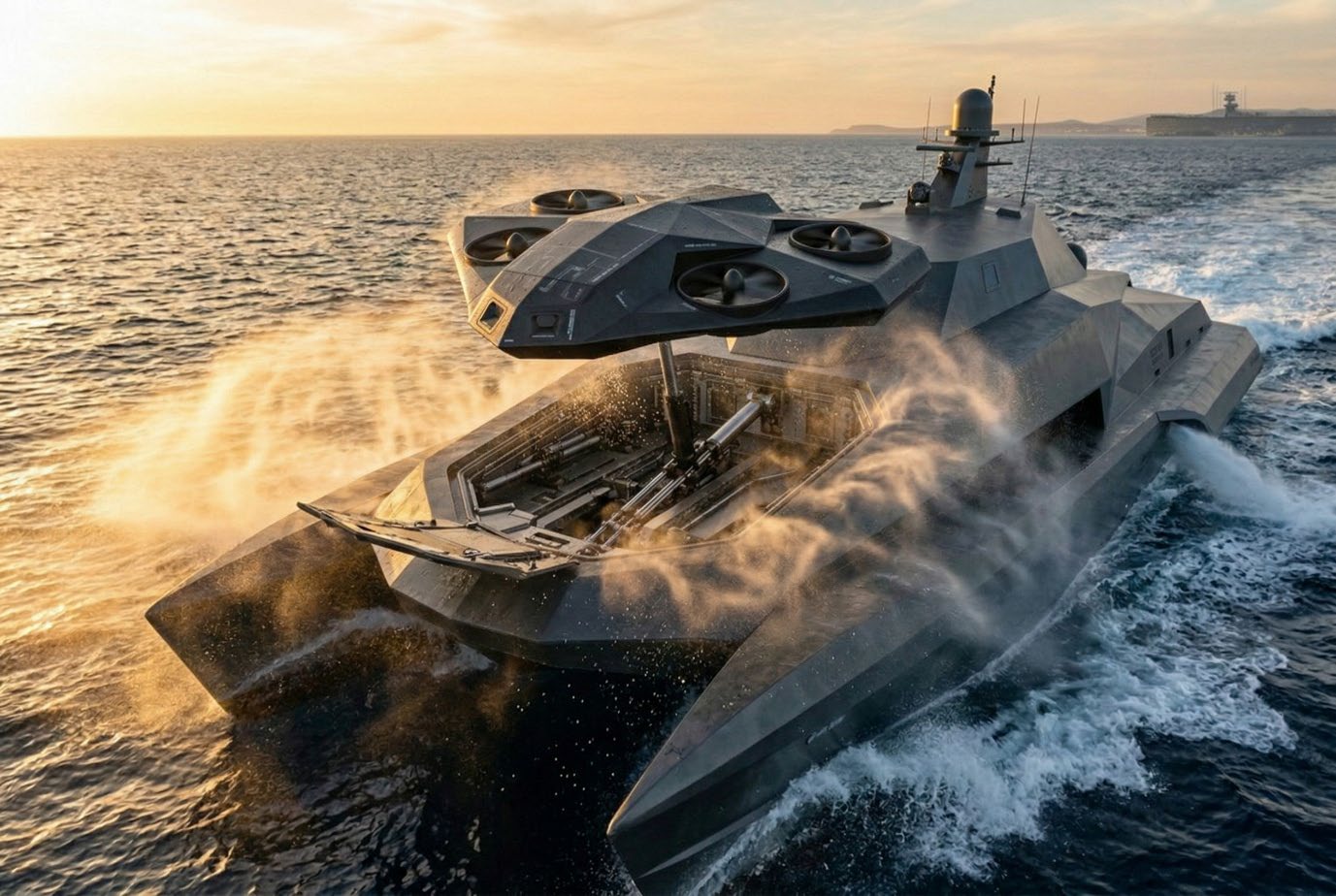
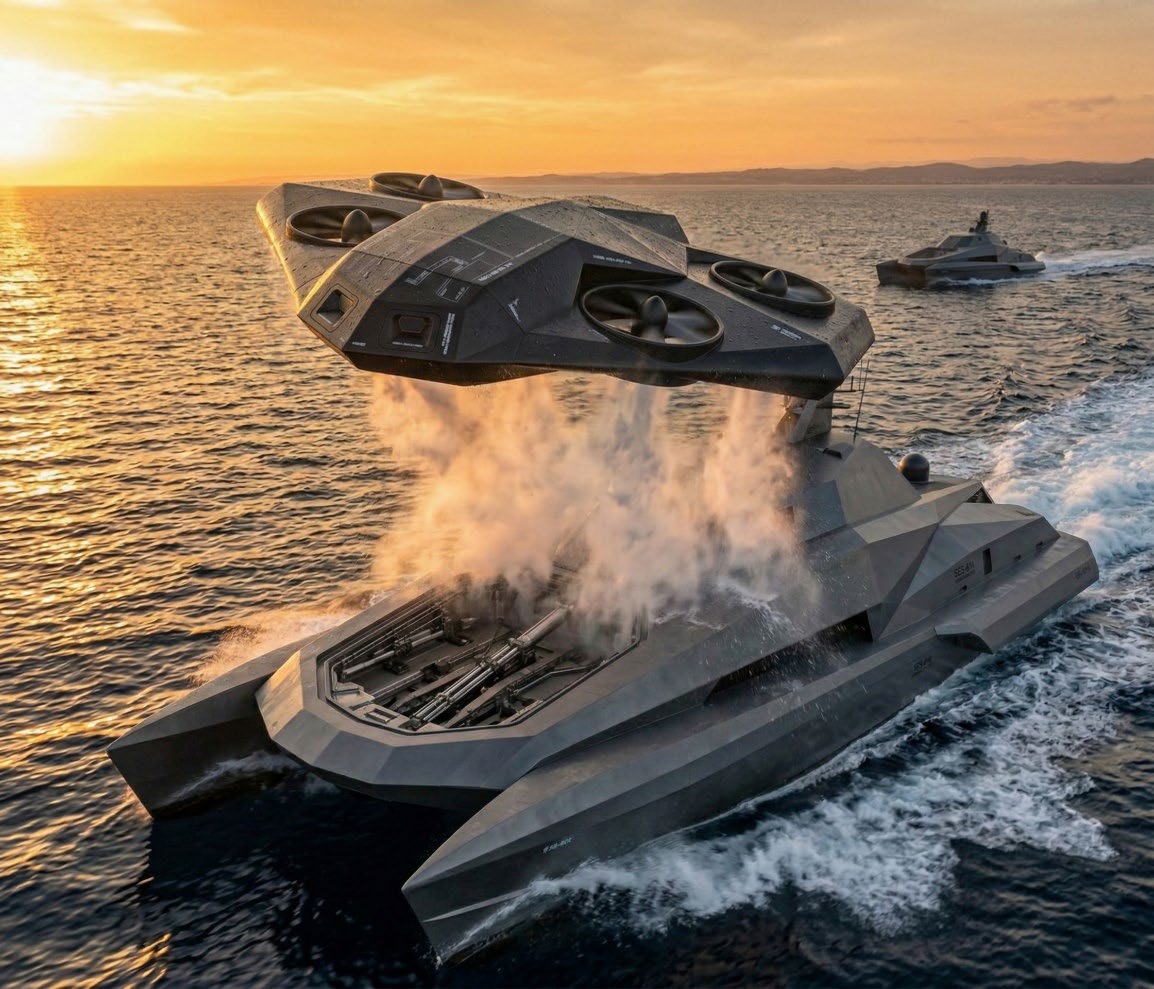
One of the most distinctive elements of the SES-34 concept is an integrated aerial platform with vertical take-off and landing capability. Its purpose is to extend what the surface platform can observe and to support a broader understanding of the operating area.
The meaningful innovation is the relationship between the two vehicles. The vessel provides a base, resources and an operational reference. The aircraft can provide a different perspective. Their information must be interpreted together, and their activities must be coordinated around shared objectives and the limitations of each platform.
A launch is consequently more than a command to fly. Conditions, available energy, recovery options and the vessel's own state all matter. The engineering programme has to address the complete sequence, including stowage, deployment, flight, return and the handling of conditions in which a planned operation should not proceed.
That makes the aerial element a useful example of what we mean by system autonomy: separate physical capabilities connected through shared context and governed decisions. Integration is the work required to make those capabilities useful together.
Designed for an operating life, not only a demonstration
The SES-34 technical programme also places emphasis on modularity, access and replaceable components. These may be less spectacular than a synthetic pilot, but they are central to whether an advanced platform can become useful beyond a demonstration.
A system that is difficult to inspect, diagnose or repair creates operational constraints of its own. Physical access, component replacement and the separation of functional modules help define a credible maintenance strategy. Monitoring can support that strategy by showing changes in condition before they become mission-ending faults, provided that the sensing and interpretation are validated.
For a cognitive pilot, equipment health is not background data. It changes the set of reasonable actions. An autonomous system should recognise a narrowing operating envelope and respond within authorised procedures. The ambition is not to conceal uncertainty or degradation, but to make them visible enough for the machine and its operator to act on them.
Where the platform could make a difference
The SES-34 concept is relevant to maritime security, offshore infrastructure observation and other demanding operations that benefit from persistent awareness and an unmanned presence. Its integrated aerial perspective could help relate a surface-level observation to a wider situation. Its cognitive architecture could help maintain context across an extended operation.
These are applications to explore and qualify, not proof that the complete platform already performs them in operational service. The value proposition rests on a combination of capabilities: mobility, persistent observation, coordinated sensing, equipment awareness and governed execution. Each application would require its own operating assumptions, evidence and acceptance criteria.
For Reinventy, this breadth is also an opportunity to test a deeper proposition: can a common synthetic-intelligence architecture be specialised for different physical domains without losing its governance, memory and ability to connect decisions to evidence? Peregrine X asks that question in flight. SES-34 asks it at sea, with a different environment and a different set of consequences.
The next milestone is evidence from the complete system
The technical roadmap moves through material characterisation, electric-machine and controller testing, cognitive-system evaluation, structural development and integrated platform testing. Sea trials belong to that progression. They are not a result that can be inferred from a design document or from the success of an individual component.
This distinction is essential. A material result, a motor bench test, a software demonstration and a complete maritime platform answer different questions. Combining them requires evidence at the interfaces as well as evidence for each component. Physical performance, dependable autonomy and the ability to handle abnormal conditions must ultimately be demonstrated together.
The illustrations in this editorial are project concept visualizations drawn from Reinventy's technical programme. They communicate the intended platform and integration approach. The programme description presents engineering objectives and development direction; it does not announce a completed, certified or operationally proven vessel.
My view is that the most compelling part of SES-34 is precisely this convergence. The ambition is not simply to build an unmanned vessel, or to place an intelligent assistant on board. It is to make a physical platform, its protective technologies, its electric motion and its synthetic pilot work as an understandable system under human authority. That is the naval expression of the Reinventy vision, and the standard against which its progress should be judged.
Explore the programme
Discover the public SES-34 platform profile: https://reinventy-solutions.ca/platforms/ses-34
Meet Tin Man, Reinventy's synthetic copilot: https://reinventy-solutions.ca/technologies/tin-man
Read the previous weekly editorial on Peregrine X: https://herald.reinventy-solutions.ca/weekly-editorial/peregrine-x-where-reinventy-technologies-take-flight