
Inside Cerbero: engineering an AI agent to defend the network
· By Antonio Sedino, CTRO · Reinventy Solutions Corp.
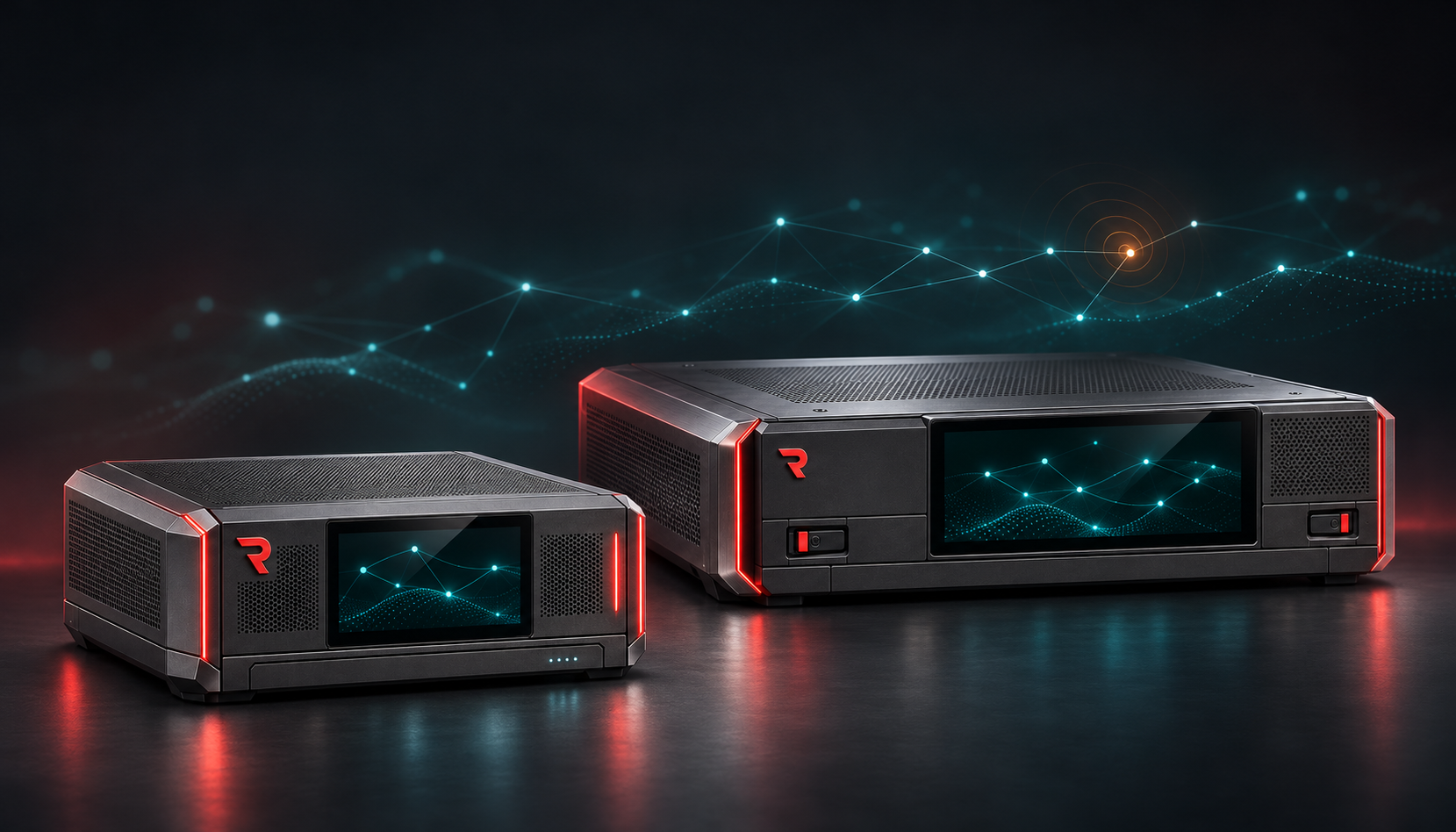
From packets to evidence, from evidence to intervention. A technical journey through Reinventy’s architecture: three responsibilities, two model families and one decisive principle — intelligence proposes, authority stays bounded.
A shop, a business, a critical infrastructure site: when something changes on the network, receiving an alert is only the beginning. The harder questions are what happened, which evidence supports the suspicion and which intervention would be proportionate. Cerbero is being developed around this need: bringing an AI agent close to the network it is intended to help protect.
This Reinventy product is in development. Its software prototype and component-level tests provide a starting point; the appliances shown are industrial design concepts, not photographs of units already on sale. HERALD is a Reinventy Solutions Corp. publication: this editorial presents a project from the same company.
Three responsibilities, one continuous cycle
The architecture assigns three roles. Sentinel collects network signals and sensor findings, retaining their origin, observation time and freshness. Analyst connects the clues and prepares a bounded investigation, separating observed facts from hypotheses. Guardian applies deterministic policies and checks the scope of permitted actions.
These are not three models with unrestricted freedom to act. They are complementary responsibilities within a cycle: observe, investigate, propose, verify. A model response does not, by itself, authorise a network change. Sensitive interventions pass through separate controls, explicit limits, expiring effects and checks on the outcome.
Inside the appliance: three planes to keep distinct
To understand Cerbero, start with what crosses the device: packets. The data plane forwards traffic and applies configured network rules. The analysis plane receives observations, reconstructs context and produces hypotheses. The control plane determines which changes are permissible. This is a teaching view of the proposed architecture: the functions must cooperate without becoming a single chain dependent on the model.
For Sovereign, the design assigns switching to a dedicated ASIC — a circuit specialised in network processing — while Thor hosts the agent and analysis. The firewall and IDS sensors, which flag suspicious activity, have their own processing path to size. No language model should have to read each packet to authorise its passage. Slower inference must not make the network wait for the next generated word.
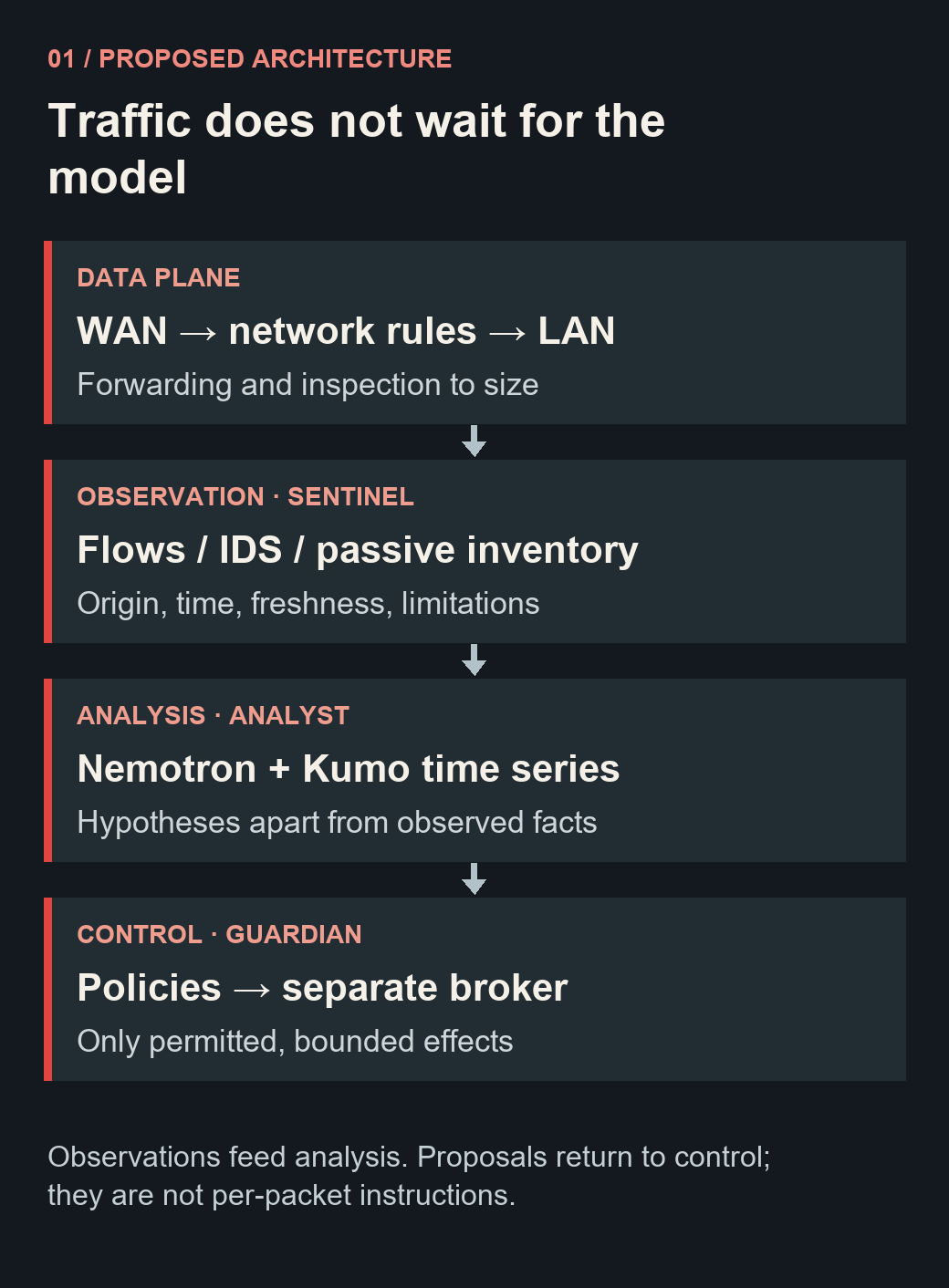
Traffic does not wait for the model
- DATA PLANEWAN → network rules → LANForwarding and inspection to size
- OBSERVATION · SENTINELFlows / IDS / passive inventoryOrigin, time, freshness, limitations
- ANALYSIS · ANALYSTNemotron + Kumo time seriesHypotheses apart from observed facts
- CONTROL · GUARDIANPolicies → separate brokerOnly permitted, bounded effects
Observations feed analysis. Proposals return to control; they are not per-packet instructions.
This separation also resolves a common misunderstanding: port speed, forwarding speed and inspection speed are different measurements. A 25 GbE port describes an interface; it does not certify a firewall that can inspect 25 Gb/s, let alone AI or TLS analysis at that rate. In Cerbero, these capabilities will need separate measurements, including packet loss, latency and behaviour under load.
Observation points matter too. If two devices communicate within a segment without crossing Cerbero or a dedicated sensor, the gateway does not automatically see their exchange. Separating payment systems, guests, offices and equipment through VLANs only provides the intended controls when paths between zones traverse explicit enforcement points. Encrypted traffic exposes the metadata available to the sensors; inspecting TLS content would require a separate design, not a magical property of AI.
Evidence quality comes before intelligence
A useful alert must answer simple questions: who observed it, when, where and with what limitations? Sentinel is intended to collect flows, IDS findings and passive endpoint observations. A passive inventory describes devices seen on the network; an address alone does not certify a physical machine or its business role.
Freshness is part of a data point’s meaning. Incomplete capture and stale telemetry must remain visible in an investigation: no observations and no threats are different conditions. Evidence-linked revisions in the prototype also help reconstruct which information supported a proposal. An explanation helps the operator when it can be checked, not merely when it sounds convincing.
Nemotron for reasoning, Kumo for patterns over time
The planned local analysis path uses NVIDIA Nemotron with TensorRT Edge-LLM, NVIDIA’s C++ inference framework for embedded systems. Its intended role in Cerbero is to help interpret evidence and formulate explanations that can be checked. Final integration and diagnostic quality on the product still require qualification.
Kumo Forecast addresses a different problem: it is a model for multivariate time-series forecasting. The project is evaluating it for traffic and capacity trends. An isolated GPU proof exists; resident integration and preventive effectiveness within Cerbero have not yet been demonstrated.
That distinction matters. A trajectory towards saturation or a departure from usual behaviour may justify an earlier investigation; it does not establish that an attack will happen. Prevention also requires reliable sensors, context, policies and measurement of false alarms. Reinventy’s proprietary contribution lies in orchestration, the evidence model, controls and product integration; third-party models retain their respective licences.
The model workshop: language, time and resources
Nemotron and Kumo are not two names for the same function. In Cerbero’s design, the first path helps Analyst reason about evidence; the second studies how quantities change over time. Think of two separate questions: “which observations support this hypothesis?” and “how might this series evolve if the observed behaviour continued?”. Their answers meet in an investigation; they do not automatically become firewall instructions.
TensorRT Edge-LLM is the planned execution engine for local language inference. The design preference for INT4 concerns quantisation: representing selected weights at reduced precision to limit memory requirements. It does not automatically divide total system memory by four. Context, inference caches, buffers and sensors still need resources; answer quality and practical gains must be measured with the selected model.
NVIDIA’s documentation describes KumoForecast as a multivariate time-series model with optional historical covariates. To illustrate the Cerbero use case, imagine synchronised series for traffic and capacity pressure: these are examples of inputs to design, not a qualified product schema. Sampling intervals, missing data and the selected horizon affect what a forecast means.
A departure from normal behaviour could indicate an attack, a legitimate update or a change in business hours. Forecasting, anomaly detection and attributing a threat are therefore distinct problems. Kumo Anomaly and other specialists are possible extensions mentioned in the roadmap; the isolated Kumo Forecast proof does not show that they are already integrated.
On the local node, models also share finite CPU, GPU, memory and energy budgets. The design requires bounded queues and priority for networking. The engineering question is not just “does the model start?”, but “what happens to the network when the model is busy, exceeds its budget or stops responding?”.
From a signal to an explainable decision
Imagine an unusual rise in connections and network pressure. This illustrates intended operation, rather than describing a real incident. Sentinel would document the event; temporal analysis would help describe its trend; Analyst would compare the clues with available context. A legitimate demand spike could also explain it.
The operator should see which data support the hypothesis, what is missing and which action is proposed. Guardian would check whether that action is permitted. Essential traffic, meanwhile, must not wait for a model to finish generating text: the design separates the network path from AI investigation and bounds the resources allocated to inference.
A proposal is not yet permission
Consider another teaching example: a surveillance device starts contacting unusual destinations. A sound workflow must first verify the observation, then distinguish possible explanations. A vendor update and a compromise can produce partly similar clues. The device’s identity and importance must be established before proposing an effect on the network.
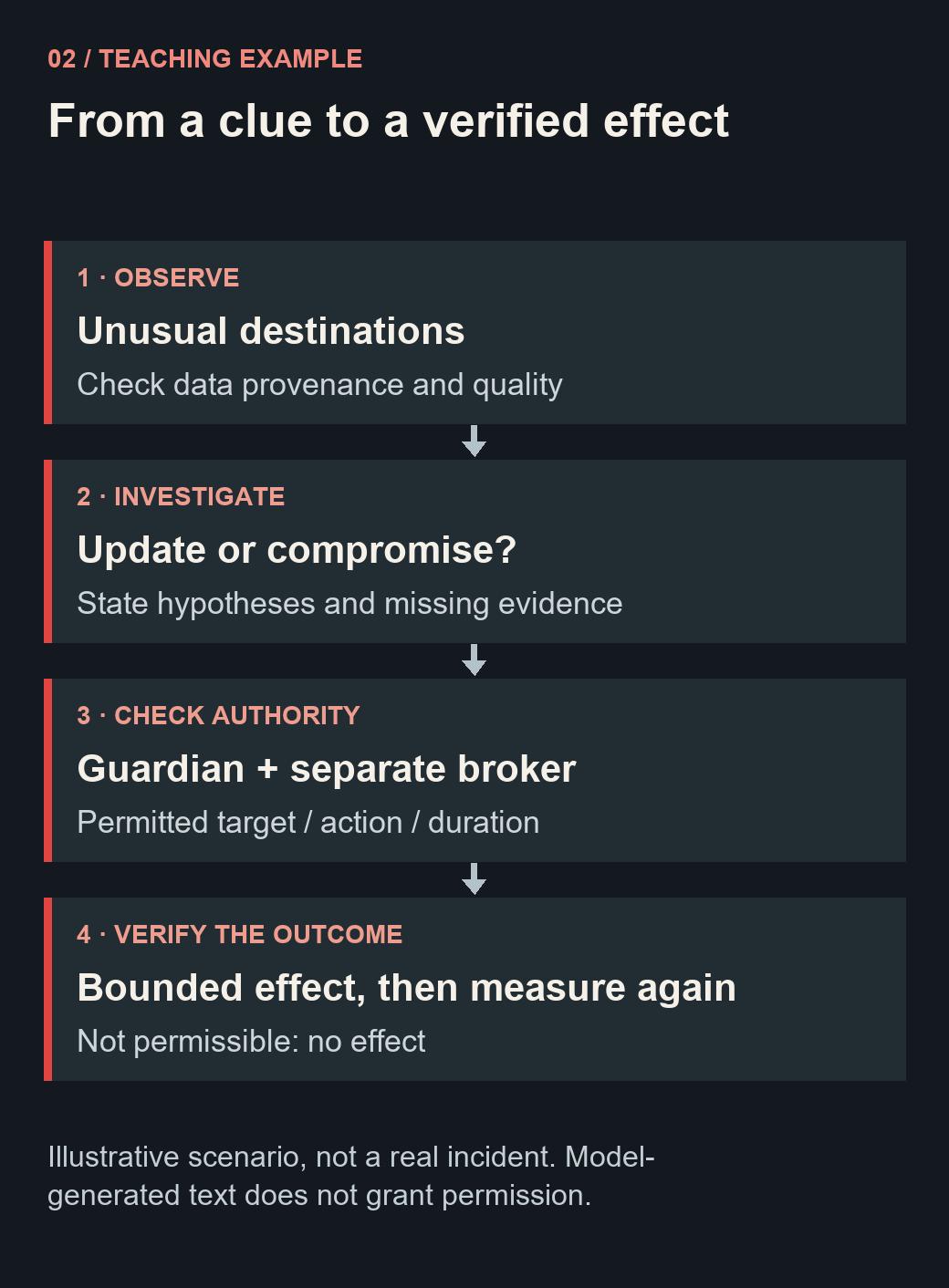
From a clue to a verified effect
- 1 · OBSERVEUnusual destinationsCheck data provenance and quality
- 2 · INVESTIGATEUpdate or compromise?State hypotheses and missing evidence
- 3 · CHECK AUTHORITYGuardian + separate brokerPermitted target / action / duration
- 4 · VERIFY THE OUTCOMEBounded effect, then measure againNot permissible: no effect
Illustrative scenario, not a real incident. Model-generated text does not grant permission.
In Cerbero’s design, Guardian checks whether a proposal is permissible, while a separate broker controls execution. This separation is substantive: text generated by Analyst must not turn itself into an operational rule. Scope must specify the target, permitted action and duration. Isolated firewall-effect checks also cover kernel-level expiry and process failures; they do not yet constitute inline qualification on a customer network.
After any intervention, the outcome needs checking. Requesting a change does not prove it was correctly applied or solved the problem. The cycle returns to observations: the actual effect, continued service availability and a documented result. If evidence is insufficient, the useful outcome can be a request for verification rather than an automatic block.
The Tin Man-inspired console should make this chain readable: incidents, evidence, hypotheses and proposed actions, alongside machine health where sensors make it available. Planned Riva-based voice interaction remains an interface too: speech alone grants no authority for sensitive interventions.
Two formats, different needs
Edge Pro is intended for shops, retail sites and small and medium-sized businesses: a compact appliance with a local console and processing close to the data. Sovereign targets organisations with greater capacity, control and integration needs. Hardware configurations are design targets, not certified performance claims.
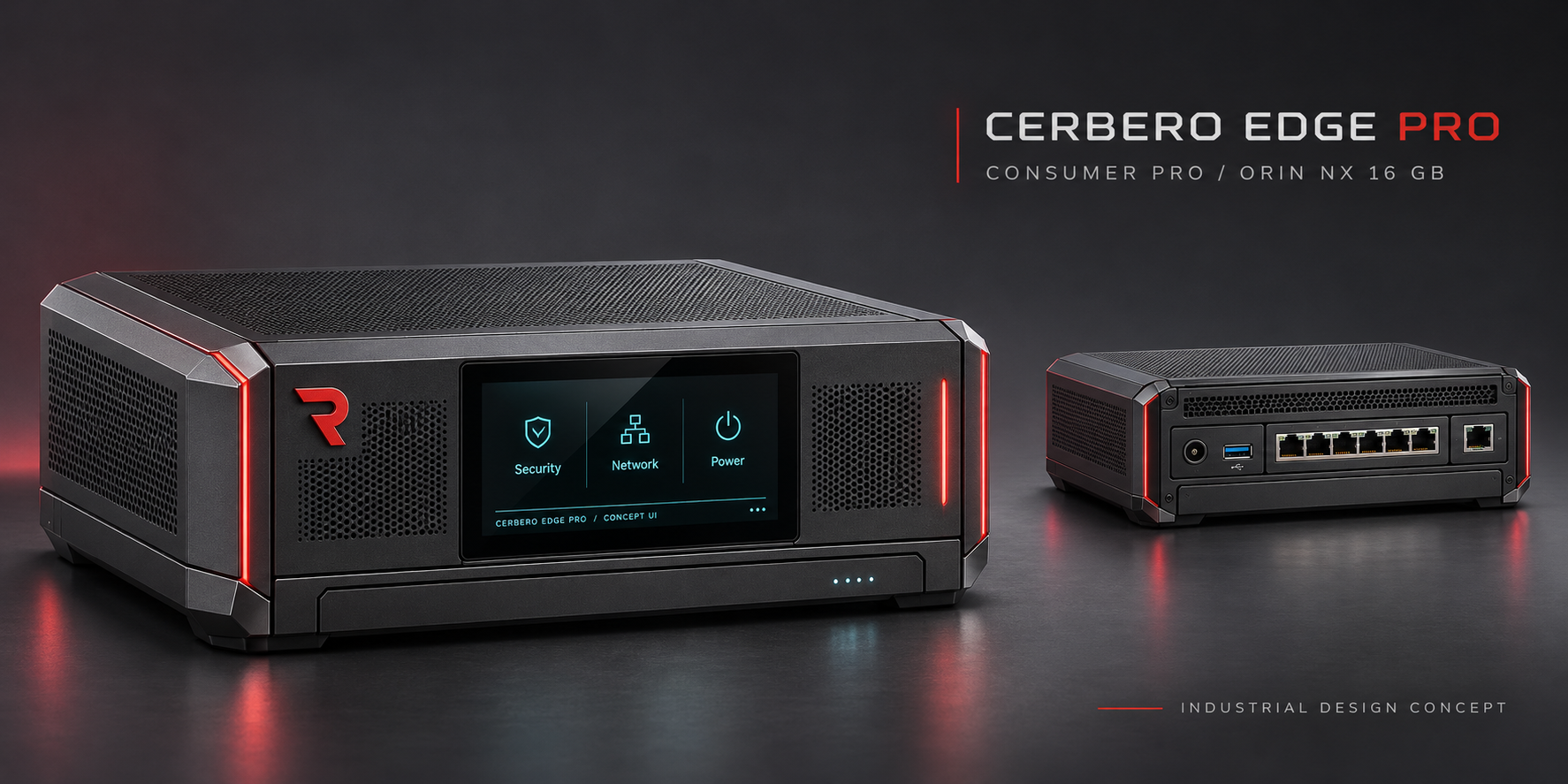

Sovereign is also envisaged as a possible dedicated security module within the THOLON ecosystem. Cerbero draws on the Tin Man family’s approach and interface, while using a dedicated security runtime: that connection does not mean every Tin Man capability is available in the product.
Reading specifications without confusing targets and measurements
The table summarises targets in the product kit dated 8 November 2026. They are design choices requiring engineering, not configurations already on sale or benchmark results.
Hardware targets · kit 08/11/2026
Compute
Edge Pro: Orin NX · 16 GB
Sovereign: Thor T5000 · 128 GB
Planned storage
Edge Pro: 1 × 1 TB NVMe
Sovereign: 2 × 2 TB NVMe
Data ports
Edge Pro: 6 × 2.5 GbE RJ45
Sovereign: 8 × 2.5 GbE + 12 × 10 GbE + 4 × 25 GbE
Separate management
Edge Pro: 1 × 1 GbE
Sovereign: 1 × 1 GbE
Touchscreen
Edge Pro: 5 inch
Sovereign: 7 inch
Planned DC UPS
Edge Pro: 153.6 Wh
Sovereign: 307.2 Wh
Sovereign’s larger memory expands the room available for models and investigations; it does not automatically demonstrate more accurate diagnoses. Ports require suitable carriers, buses, optics and thermal design. THOLON envisages Sovereign as an additional security module, rather than implicitly consuming one of its ten compute nodes. The twelve planned 10 GbE ports could serve those nodes and two support services, but assignments and real capacity still need validation.
Continuity beyond the individual alert
The design includes alternative network connections and backup power for defined essential loads. A deterministic supervisor would prioritise networking and approved policies, reducing non-essential activity when necessary. A connection change can still interrupt a session; a dedicated battery does not automatically power an entire site.
When power fails: a lesson in systems engineering
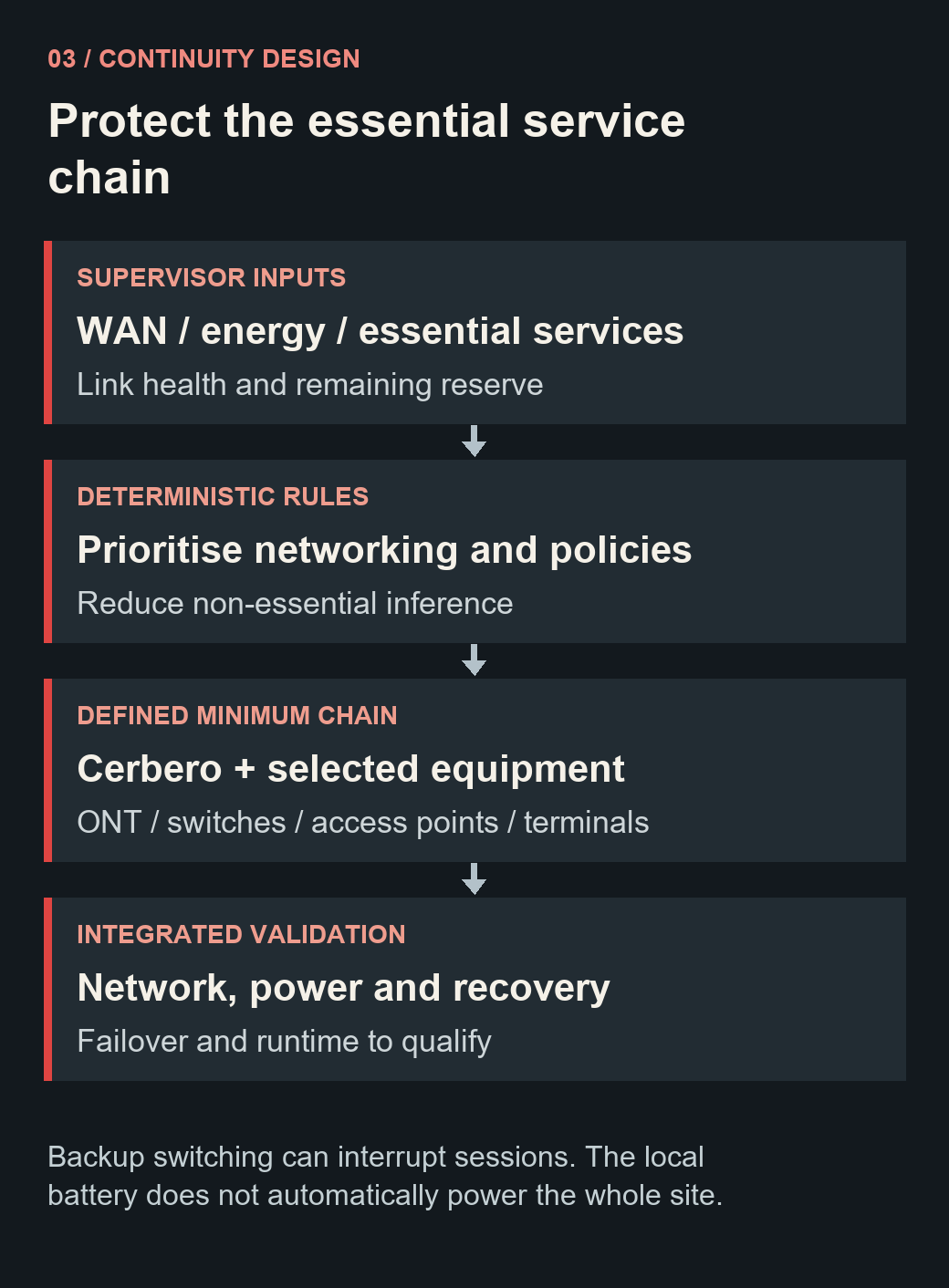
Protect the essential service chain
- SUPERVISOR INPUTSWAN / energy / essential servicesLink health and remaining reserve
- DETERMINISTIC RULESPrioritise networking and policiesReduce non-essential inference
- DEFINED MINIMUM CHAINCerbero + selected equipmentONT / switches / access points / terminals
- INTEGRATED VALIDATIONNetwork, power and recoveryFailover and runtime to qualify
Backup switching can interrupt sessions. The local battery does not automatically power the whole site.
Continuity depends on more than the firewall’s battery. If the ONT, switches, access points or essential terminals lose power, connectivity may be unusable even while Cerbero remains on. The design must identify a minimum service chain and add up its consumption. A satellite terminal remains external; it is not contained in the appliance.
The kit provides a reproducible study calculation: hours of operation = nominal Wh × usable fraction × efficiency × state of health ÷ total watts. With 153.6 Wh, a usable fraction of 0.80, efficiency of 0.90, a new battery and a hypothetical 65 W load, the result is approximately 1.70 hours, or 1 hour 42 minutes. This calculates the design assumptions; it is not a measured Cerbero runtime.
Additional loads shorten that time; temperature and ageing change the budget. Reducing non-essential inference during an interruption therefore has a concrete purpose: reserving energy for networking and selected services. The continuity supervisor must follow deterministic rules without waiting for a language-based assessment.
How to demonstrate that the product works
The technical report documents a persistent core, a candidate console, passive inventory and isolated firewall-effect tests. This is prototype work. Qualifying the integrated appliance requires answers to further questions.
Detection — Which threats are detected, and how often is legitimate activity mistaken for a threat?
Networking — How much traffic is forwarded and inspected, with what latency and loss?
Failures — What happens if the model, a sensor or a control process stops responding?
Continuity — Which services remain available during loss of WAN connectivity or power?
Operations — Are installation, updates, recovery, compliance and support ready?
This is the most interesting part of Reinventy’s project: connecting observation, investigation and bounded intervention, with connectivity and energy included in the same systems design. It goes beyond adding a chat interface to network equipment. It is a concrete product direction to verify in the field. Innovation becomes demonstrable when every step retains its evidence and behaviour remains controllable when a component stops working.
Documentary basis: Cerbero kit v2 and technical report v0.2 dated 8 November 2026, sections 01–09. Original editorial diagrams derived from the design; they are not implementation drawings or evidence of an installed configuration. Model descriptions refer to the NVIDIA primary sources below.
Further reading and sources
Cerbero product page · IT
https://reinventy-solutions.ca/it/platforms/cerbero
Cerbero product page · EN
https://reinventy-solutions.ca/en/platforms/cerbero
Cerbero product page · FR
https://reinventy-solutions.ca/fr/platforms/cerbero
The Reinventy website · IT
https://reinventy-solutions.ca/it
The Reinventy website · EN
https://reinventy-solutions.ca/en
The Reinventy website · FR
https://reinventy-solutions.ca/fr
Tin Man OS Edge · IT
https://reinventy-solutions.ca/it/products/tin-man-os/edge
Tin Man OS Edge · EN
https://reinventy-solutions.ca/en/products/tin-man-os/edge
Tin Man OS Edge · FR
https://reinventy-solutions.ca/fr/products/tin-man-os/edge
The THOLON platform · IT
https://reinventy-solutions.ca/it/platforms/tholon
The THOLON platform · EN
https://reinventy-solutions.ca/en/platforms/tholon
The THOLON platform · FR
https://reinventy-solutions.ca/fr/platforms/tholon
NVIDIA TensorRT Edge-LLM
https://github.com/NVIDIA/TensorRT-Edge-LLM
NVIDIA Structured Data Models · Kumo Forecast
https://nvidia.github.io/structured-data-models/api/generated/sdm.models.KumoForecast.html